The choice between Big Data vs Traditional Data is no longer just a technical debate for the server room. It’s a critical pivot for every C-suite executive in the Middle East today. As Dubai pushes toward its D33 Economic Agenda, being able to handle information at scale is the ultimate way to stand out. Traditional frameworks are simply hitting a wall. They can’t keep up with the mountain of signals coming from modern commerce. At UpstartAI, we help regional leaders navigate this shift, moving from static old reports to real-time, predictive intelligence that actually grows the bottom line.
In the real world, the truth is that the old ways of handling information are reaching their limit. We’re seeing a massive wave where companies in Abu Dhabi and Dubai are walking away from rigid, slow setups and moving toward fluid, high-velocity environments. This change lets you see the “why” behind your numbers, not just a stale list of “what happened.” By embracing a more modern approach, your organization turns data from a monthly storage bill into a powerful engine for making faster, smarter choices in a market that never sleeps.
Schedule a Free Call Today
Certified Experts | UAE-Wide Clients | ROI-Focused Campaigns | 10+ Years Experience
Navigating the Shift: Big Data vs Traditional Data
The regional business landscape is moving at lightning speed, and the tools we use have to keep up. Think of it this way: a real estate group in Dubai South needs much more than just a list of property sales from last month. They need to understand live market vibes, social media trends, and even weather patterns that might slow down construction. This is exactly where Big Data vs Traditional Data comes into the picture. The former lets you pull in massive, messy streams of information that the latter just wasn’t built to touch.
In the UAE, staying on the right side of the Federal Tax Authority (FTA) for VAT or keeping up with the latest UAE Data Office privacy laws requires a level of precision that legacy tools find tough to maintain. Centralizing your info into a single “brain” stops your departments from working in bubbles. It prevents “data drift,” where your marketing team in Sharjah is looking at totally different figures than your finance team in Abu Dhabi. When everyone is on the same page, your strategy becomes much harder to break.
The reality is, if you want to use AI or machine learning properly, you can’t feed it limited or messy info. It just won’t work. Modern frameworks act like a high-end filter, cleaning up the static so your AI models actually provide value you can see. This ensures that every Dirham you spend on Business Intelligence actually makes its way back to you. It keeps you from throwing budget at ad campaigns that aren’t hitting and helps you tighten up operations, from staffing levels to how much energy you’re using to keep your offices cool.
Scaling with Big Data vs Conventional Data Systems
Picking the right tech stack is probably the most important choice your CTO will make this year. Right now, the market is flooded with options, but in the Emirates, things are even more complex. You have to think about where your data actually sits-is it in a local Azure region or an on-premise server in the DIFC? Just because a system works for a firm in London doesn’t mean it’s going to pass the local security checks for a government-linked entity here. Comparing Big Data vs Conventional Data Systems helps clear up which path actually meets these tough local standards.
When we look at platforms for our clients, we focus on three main things: how it scales, how it talks to other software, and how safe it is. Scaling is huge. You need to be able to crank up your power during the Dubai Shopping Festival and then dial it back when things get quiet so you aren’t paying for empty server space. It also has to play nice with SAP, Oracle, or whatever legacy ERP tools you’ve been using for years. Since NESA guidelines are no joke, security has to be in the DNA of the system from day one.
The truth is, Big Data vs Conventional Data Systems isn’t just about the size of the files; it’s about speed. Conventional systems usually handle information in “batches,” meaning you might be looking at yesterday’s news. Modern systems handle things in real-time. For a logistics firm in Jebel Ali, knowing a shipment is delayed the second it happens-rather than a day later-is the difference between a happy customer and a lost contract. UpstartAI makes sure your tech is built for that kind of responsiveness.
Bridging Modern Data vs Legacy Data Systems
With the UAE government pushing for a “Cloud First” mentality, moving away from old, heavy hardware is just the next logical step. Modern Data vs Legacy Data Systems represent two totally different eras of doing business. Legacy systems are like heavy metal filing cabinets—reliable, sure, but slow and a nightmare to move. Modern systems are more like a digital nervous system, instantly sending signals wherever they need to go. For a hungry startup in the Dubai Future District, being able to turn on a massive analytics engine in a few hours is a total game-changer.
However, making this move in the Middle East takes some local know-how. Now that global cloud providers have opened up local data centers right here in the UAE, those old worries about data staying in the country are mostly gone. You can now have the same level of security as a server in your own basement, but with much better recovery if something goes wrong. This is massive for companies looking to expand into Saudi Arabia or the rest of the GCC, where you need to sync info across borders without breaking any regional laws.
In the real world, the cloud is about much more than just storage; it’s about acting in the moment. Imagine a retail chain in Abu Dhabi that can change its prices on the fly because it sees what competitors are doing or how people are feeling on social media. That only happens if you choose Modern Data vs Legacy Data Systems and fully embrace the cloud. UpstartAI makes this move easy. We handle the messy work of moving your old files into a new, fast system so you don’t have to worry about losing important history.
Big Data Analytics vs Traditional Analytics in the GCC Market
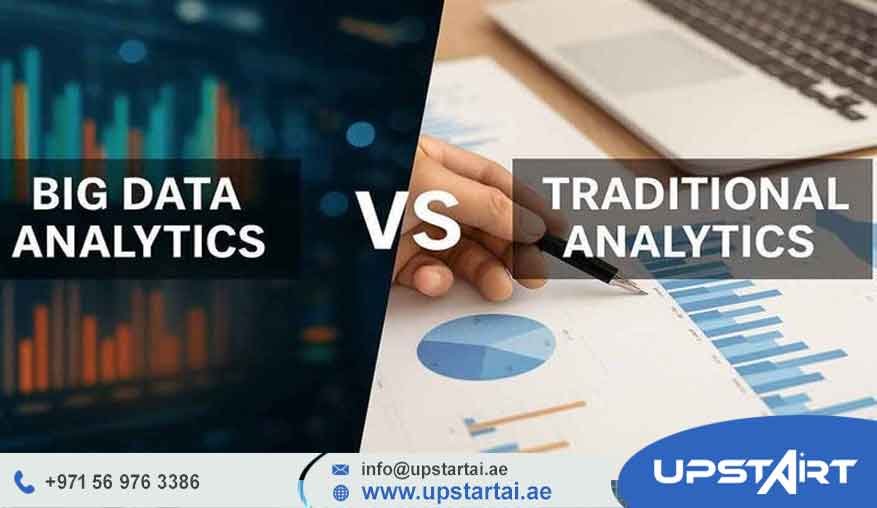
At the end of the day, a successful business in the UAE needs all its parts to speak the same language. Big Data Analytics vs Traditional Analytics represents the difference between looking through a tiny keyhole and looking through a wide-open window. Traditional methods usually focus on “what happened” in the past. Big data looks at “what is happening” right now and tries to guess “what will happen” tomorrow. In a market as competitive as Dubai, even a tiny 1% boost in how you do things can mean millions of Dirhams in extra profit.
Using these advanced methods also means you don’t have to call the IT guy every time you need a simple chart. With the right setup, a manager can pull their own reports and see live updates whenever they want. This builds a culture where people actually use facts to make their points, rather than just being the person with the loudest voice in the room. We build these systems to be easy to navigate, so your team feels empowered to look at the numbers themselves without needing a PhD in data science.
You also see the money come back when you find new ways to sell. By looking at how people have bought from you in the past, a smart system can show you opportunities you never saw before. For example, a bank might realize that people getting a mortgage in Dubai are usually looking for specific wealth management help at the same time. Choosing Big Data Analytics vs Traditional Analytics gives you the vision to spot those patterns, helping you keep your customers around longer in a very crowded market.
Advanced Data Processing vs Legacy Processing for ROI
Setting up a modern setup isn’t a “set it and forget it” task. It needs constant care to stay fast. Comparing Advanced Data Processing vs Legacy Processing is vital when you’re looking at the bottom line. Legacy processing is often slow and prone to tripping up when the volume gets too high. Advanced processing uses automation and clever computing to handle massive loads without breaking a sweat. This ensures your dashboards stay live even during your busiest traffic spikes.
At UpstartAI, our services combine deep tech skills with a real understanding of the local UAE market. We know that data here can be tricky-you might have names written in three different ways or files that switch between Arabic and English. We spend a lot of time “cleaning” that data so the answers you get are actually right. It’s all about avoiding the “garbage in, garbage out” problem that ruins so many big tech projects. Our focus is always on a clear signal, not just a mountain of noise.
Our managed services also mean we are watching your systems 24/7. We handle the heavy lifting, like managing indexes and keeping the pipes tidy, so your own IT team can focus on actually growing the business. Whether you’re a government office in Umm Al Quwain or a global firm in Ajman, we’re here in your time zone to fix things fast. You get experts who actually know the local infrastructure and how to make it work for your specific business goals.
Understanding the Role of Structured vs Unstructured Data
In the old days, computers only liked info that fit into neat rows and columns. That’s what we call structured data. But today, most of the info we create—emails, videos, social posts, and voice notes—doesn’t fit into those tidy boxes. This is the world of Structured vs Unstructured Data. If your business is only looking at the neat stuff, you’re missing about 80% of the real story. To stay ahead in the UAE, you need a system that can read between the lines and analyze it all.
Modern systems let you store everything in its raw form and only organize it when you have a specific question to answer. This is much more flexible than old-school databases. For a real estate firm, this might mean analyzing thousands of property photos to see which kitchen features are trending in Al Reem Island. By understanding Structured vs Unstructured Data, you can unlock insights that were hidden in plain sight, giving you a massive lead over competitors who are still manually reading through PDF reports.
This flexibility also helps your wallet. You can store huge amounts of raw data very cheaply and only pay for the expensive “brain power” when you’re actually running an analysis. This makes your budget go much further. UpstartAI helps you design a “Data Lake” that holds everything securely. This ensures that as AI technology gets even better next year, you already have all the “raw material” ready for it to start learning from.
Data Evolution in Enterprises: A UAE Case Study
A major logistics and shipping provider in Jebel Ali Free Zone was struggling with slow reports and fragmented info across its regional offices. By partnering with UpstartAI, they moved away from their legacy limits and embraced Data Evolution in Enterprises. We integrated their fleet tracking, customs paperwork, and financial software into one central hub. This allowed them to see exactly where every container was and how much it was costing them in real-time.
Within eight months, the provider saw an 18% jump in how efficiently they ran. The automated alerts for customs delays meant they could reroute shipments before they became a massive headache, saving thousands in port storage fees. This success story proves that technical maturity is a direct driver of commercial success in the UAE. It shows that moving with the times isn’t just a trend—it’s a fundamental shift in how successful businesses survive in the modern world.
Frequently Asked Questions
Why is Big Data vs Conventional Data Systems better for startups in Dubai?
Startups need to move fast and change direction on a dime. Conventional systems are often too stiff and expensive to set up from day one. Modern systems let startups start small and scale their costs exactly as they grow, providing enterprise-grade power without a massive upfront bill.
How does Modern Data vs Legacy Data Systems affect VAT reporting?
Legacy systems often require a lot of manual typing and checking, which leads to mistakes in FTA filings. Modern systems automate the collection of transaction data across all Emirates, ensuring your VAT returns are accurate, compliant, and ready to go at the touch of a button.
Can Big Data Analytics vs Traditional Analytics improve my PPC campaigns?
Absolutely. Traditional analytics might tell you which ad got a click, but big data analytics can connect that click to a user’s entire journey across your site, social media, and even your offline stores. This helps you spend your budget only on the leads that are actually likely to buy.
Why choose Structured vs Unstructured Data handling for my business?
Most of the valuable “human” info in your business—like customer rants or meeting notes—is unstructured. By handling both, you get a much deeper understanding of your market sentiment and how your employees are actually doing than you would by just looking at sales spreadsheets.
How does Advanced Data Processing vs Legacy Processing save costs?
Legacy processing often requires expensive hardware and long hours of manual checking. Advanced processing uses cloud automation to do the same work in a fraction of the time. This reduces the need for massive IT departments and the cost of keeping big server rooms cool.
What is the timeline for Data Evolution in Enterprises in the UAE?
Most organizations can see a real shift within 3 to 6 months. We work in phases, making sure you get usable dashboards and insights early on while the deeper technical work continues in the background so your daily operations don’t have to stop.
Transforming Intelligence: Big Data vs Traditional Data
The gap between companies that use their data and those that just store it is getting wider every single day. In a place as ambitious as the UAE, sticking with old, slow systems is a dangerous move that can lead to long-term stagnation. If you stay still, you won’t just have slow reports; you’ll start losing your best customers to competitors who can see what they want before they even think to ask for it. UpstartAI is here to make sure you stay ahead of that curve.
The cost of digital stagnation is much higher than the investment needed to modernize your setup today. Every day you wait is another day of wasted marketing spend, slow operations, and missed strategic chances across the GCC. Take control of your future by building a data foundation that can handle whatever the market throws at it next.
Phone: +971 569763386
Email: info@upstartai.ae
Location: Dubai, UAE (Serving All Emirates)