
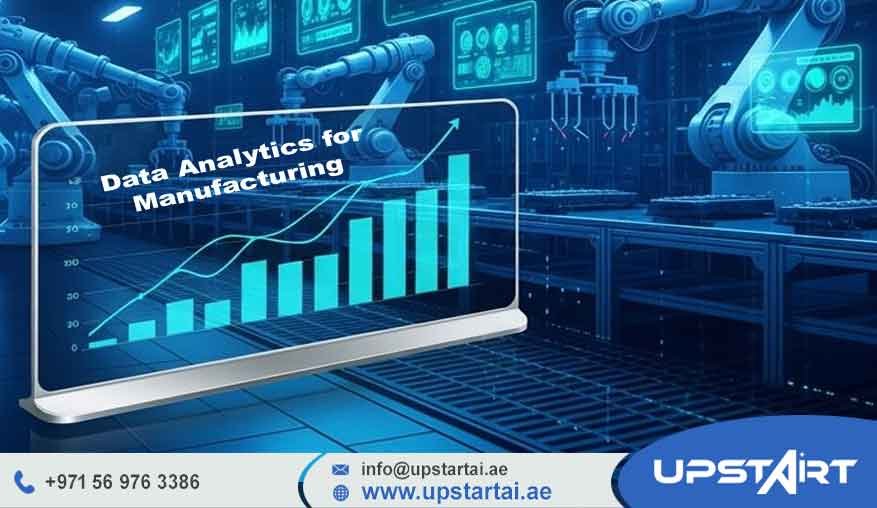
-In a region defined by rapid industrial diversification and the “Operation 300bn” mandate, precision in production is no longer a luxury-it is a survival requirement. UpstartAI provides the high-level technical architecture and predictive intelligence needed to transform raw factory floor data into a sustainable competitive advantage for Middle Eastern market leaders.
Schedule a Free Call Today
Certified Experts | UAE-Wide Clients | ROI-Focused Campaigns | 10+ Years Experience
The Strategic Imperative of Data Analytics for Manufacturing in the UAE
A New Industrial Reality in the UAE
The industrial sector across the Middle East is going through a real shift. Traditional production models are being pushed aside as businesses adapt to a fast, digital-first global economy. In major hubs like Jebel Ali and the specialized industrial zones of Abu Dhabi, Data Analytics for Manufacturing is no longer optional—it’s becoming the line between companies that lead and those that fall behind.
Today’s factories generate massive amounts of data every second. But here’s the truth—data on its own doesn’t create value. It only matters when it’s properly analyzed and turned into clear, usable insights. When manufacturers start tracking machine cycles, workforce efficiency, and production patterns in detail, they gain something powerful: control. This level of visibility helps reduce risks, especially in a world where supply chain disruptions can hit without warning.
Unlocking Cost Transparency and Operational Control
One of the biggest advantages of adopting manufacturing analytics is the ability to clearly understand where money is being spent-and where it’s being lost. In the past, many of these cost drivers were hidden inside manual reports or scattered systems.
In the UAE, this challenge is even more complex. Energy costs, compliance requirements, and frameworks like the Wage Protection System (WPS) all add layers to daily operations. Without proper visibility, small inefficiencies can quickly turn into major losses.
This is where a structured analytics approach makes a real difference. By connecting legacy machinery with modern cloud systems, businesses can break down data silos and create one unified view of operations. Instead of guessing, decision-makers can rely on real numbers. And that changes everything. Digital transformation stops being just a tech upgrade-it becomes a direct contributor to profitability.
Achieving Operational Excellence through Industrial Data Analytics Solutions
The transition toward a fully autonomous factory floor begins with the deployment of robust industrial data analytics solutions that can withstand the harsh environmental conditions of regional production sites. Whether managing a desalination plant or a high-tech electronics assembly line in Dubai Silicon Oasis, the hardware and software must be resilient. We prioritize the integration of IIoT (Industrial Internet of Things) sensors that provide a continuous stream of telemetry data, allowing for real-time monitoring of equipment health. This shift from reactive maintenance to proactive intervention is where the most immediate ROI is realized, as unplanned downtime is virtually eliminated through predictive modeling.
Modern industrial platforms must also account for the diverse technical stack found in many UAE facilities, where brand-new robotic arms often sit alongside twenty-year-old analog presses. Our methodology involves creating a middleware layer that standardizes data formats from disparate sources, enabling a “Single Source of Truth” for the entire facility. This synchronization allows for the automation of complex workflows, such as dynamic scheduling based on real-time inventory levels or fluctuating energy prices during peak summer months. By removing human bias from the decision-making loop, manufacturers can achieve a level of consistency that was previously impossible.
Beyond simple machine monitoring, these solutions extend into the realm of worker safety and productivity. By analyzing movement patterns and ergonomic data, plant managers can redesign floor layouts to minimize physical strain and reduce the risk of on-site accidents. This focus on “Human-Centric Industry 4.0” ensures that the workforce remains engaged and efficient, even as automation takes over repetitive tasks. In a market where skilled technical talent is highly contested, providing a digitally empowered workplace is a significant advantage for employee retention and long-term operational stability.
Enhancing First-Time Yield with Manufacturing Analytics Systems
Quality control in the modern era has evolved beyond end-of-line inspections into a proactive, continuous process enabled by manufacturing analytics systems. In high-stakes sectors such as aerospace components in Al Ain or pharmaceutical production in Dubai Science Park, even a 1% defect rate can result in millions of dirhams in losses and potential regulatory setbacks. We implement computer vision and deep learning algorithms that scan products at millisecond speeds, identifying microscopic flaws that are invisible to the human eye. This instantaneous feedback loop allows the system to adjust upstream parameters automatically, correcting the error at the source before a batch is wasted.
The integration of these systems also facilitates a much higher degree of traceability, which is essential for compliance with international standards and local FTA regulations. For manufacturers exporting goods globally, the ability to provide a complete digital pedigree for every unit—including raw material origin, machine temperature during production, and the specific technician on shift—is a massive competitive edge. This transparency builds trust with global distributors and reduces the administrative burden of audits and quality certifications. We focus on building these “Quality 4.0” frameworks so that our clients can achieve near-zero scrap rates while maintaining maximum throughput.
Furthermore, the data harvested by these systems provides a goldmine for R&D departments looking to optimize product designs for better manufacturability. By analyzing which design features lead to the highest number of production bottlenecks, engineers can iterate on designs that are faster and cheaper to produce without sacrificing quality. This synergy between the design office and the factory floor, powered by data-driven manufacturing, shortens the time-to-market for new products. In a fast-paced economy like the UAE, the ability to move from concept to mass production with minimal friction is the hallmark of a truly agile enterprise.
Strategic Decision-Making via Manufacturing Performance Analytics
The role of the modern COO has shifted from managing people to managing data streams, necessitating a reliance on manufacturing performance analytics to drive long-term strategy. Traditional KPIs such as OEE (Overall Equipment Effectiveness) are being reimagined through the lens of real-time data, providing a much more accurate reflection of true factory capacity. We provide executive-level dashboards that distill thousands of data points into a few critical indicators, allowing leadership to spot emerging trends before they impact the quarterly balance sheet. This visibility is particularly crucial when managing multi-site operations across different Emirates, where regional variations in logistics and utility costs must be accounted for.
Data-driven manufacturing allows for a more sophisticated approach to CAPEX planning, as leaders can see exactly which assets are nearing the end of their useful life and which ones are underperforming. Instead of relying on gut feeling or generic depreciation schedules, investment decisions are backed by hard evidence of machine performance and maintenance costs. This ensures that capital is allocated where it will have the greatest impact on total output. Additionally, these analytics provide the groundwork for “Digital Twin” simulations, where proposed changes to the production line can be tested in a virtual environment before a single piece of equipment is moved.
In the 2026 market, the ability to respond to “black swan” events—such as sudden port closures or raw material shortages—is what defines a resilient business. By integrating external market data with internal production analytics, manufacturers can pivot their operations in real-time. For instance, if a specific raw material becomes unavailable, the system can automatically suggest an alternative production schedule that utilizes available stock for different high-margin orders. This level of organizational agility is only possible when the enterprise is built on a foundation of clean, accessible, and intelligently analyzed data.
UAE Case Study: Real-Time Optimization in the Food & Beverage Sector
A large-scale dairy production facility based in the UAE recently faced significant challenges with high energy costs during peak cooling cycles and a rising rate of packaging waste. Their existing reporting was delayed by 24 hours, meaning that by the time a production error was spotted, thousands of units had already been incorrectly processed. UpstartAI was engaged to deploy a comprehensive suite of Data Analytics for Manufacturing, linking their refrigeration sensors, filling line PLCs, and warehouse management system into a unified cloud dashboard.
The transformation was immediate and measurable. By implementing predictive cooling cycles that adjusted based on ambient temperature and production volume, the facility reduced its energy spend by 14% in the first quarter. More importantly, the use of real-time vision analytics on the packaging line reduced material waste by 22%, saving hundreds of thousands of dirhams in raw materials. This case study demonstrates how technical precision and local operational context can combine to deliver a significant ROI for Middle Eastern manufacturers.
Frequently Asked Questions
What are the primary drivers for adopting data analytics for manufacturing in the UAE?
The main drivers include the need to lower operational costs in a high-competition market, ensuring compliance with strict FTA and environmental regulations, and the push toward “Industry 4.0” supported by government initiatives. By utilizing data analytics for manufacturing, firms can achieve the transparency required to optimize energy use and minimize scrap, which is critical for maintaining healthy margins. These systems also provide the data needed to secure high-value lead quality for international export contracts.
How do manufacturing data analytics improve predictive maintenance?
By monitoring vibration, heat, and acoustic signatures of machinery, manufacturing data analytics can identify the early warning signs of component fatigue long before a failure occurs. This allows maintenance teams to schedule repairs during planned downtime, avoiding the massive costs associated with an emergency production halt. Over time, these systems learn the specific stress patterns of your equipment, becoming increasingly accurate at predicting the residual life of critical assets.
What is the typical ROI timeline for industrial data analytics solutions?
Most enterprises begin to see a measurable return on investment within 6 to 12 months, primarily through reduced downtime and improved material yield. The initial costs of industrial data analytics solutions are often offset by the rapid identification of “hidden” inefficiencies in the production cycle. For many UAE firms, the ability to automate VAT reporting and compliance through these systems provides an additional layer of financial value that accelerates the payback period.
Can manufacturing analytics systems integrate with legacy machinery?
This allows businesses to digitize their operations without the massive expense of replacing their entire fleet of equipment. We focus on creating a unified data layer that treats old and new machines as part of a single, coherent ecosystem.
Why is data-driven manufacturing essential for the UAE’s “Operation 300bn”?
The national strategy aims to raise the industrial sector’s contribution to the GDP significantly, which requires a shift toward high-tech, high-efficiency production. Data-driven manufacturing provides the technical foundation for this growth, allowing local firms to compete with global giants on quality and price. It also fosters an environment of innovation, where local manufacturers can develop unique, IP-protected processes that drive further economic value.
How do manufacturing performance analytics help in multi-site management?
For companies with facilities in Dubai, Sharjah, and Abu Dhabi, manufacturing performance analytics provide a centralized view that allows for direct comparison of site efficiency. Leaders can identify which plants are performing best and transfer those “best practices” to other locations, ensuring a high standard of excellence across the entire brand. This centralized visibility is key for maintaining control over complex, geographically dispersed supply chains.
Lead the Industrial Revolution with Data Analytics for Manufacturing
The transition to an intelligent, autonomous factory is no longer a futuristic concept—it is the current standard for any firm that expects to remain relevant in the UAE’s aggressive business landscape. Organizations that continue to rely on manual reporting and reactive maintenance will find themselves unable to compete with the speed and precision of data-empowered rivals. The cost of digital stagnation is far higher than the investment required to modernize your core infrastructure today.
In an economy where every second of uptime and every gram of raw material counts, your data is your most valuable asset. Failing to harness it means leaving millions in potential profit on the factory floor. UpstartAI is ready to engineer the systems that will turn your industrial challenges into a streamlined engine for growth.
UpstartAI +971 569763386 info@upstartai.ae www.upstartai.ae