ERP for Logistics
The logistics world here in the United Arab Emirates is moving faster than ever before. With the UAE e-commerce market expected to hit 8.5 billion USD by the end of 2025, plus our big role as a global trade hub, sticking to old manual ways just won’t cut it anymore. UpstartAI offers a new kind of ERP for logistics that’s built to turn all your messy daily data into a real advantage for your business. Our AI-powered tools connect everything-from the moment a container hits Jebel Ali Port to that final delivery in a busy Dubai neighborhood.
Whether you’re running a bunch of cold-chain trucks or a big 3PL operation, our platform makes sure you can see everything that’s happening. At UpstartAI, we aren’t just selling some software; we’re giving you a specialized logistics ERP software setup that helps UAE companies grow fast while staying on the right side of local VAT and tax rules.
Safe Data: We follow all the UAE Federal Decree-Law No. 45 of 2021 (PDPL) rules to keep your info private.
Quick Setup: We get things running faster than most for businesses in Dubai and Abu Dhabi.
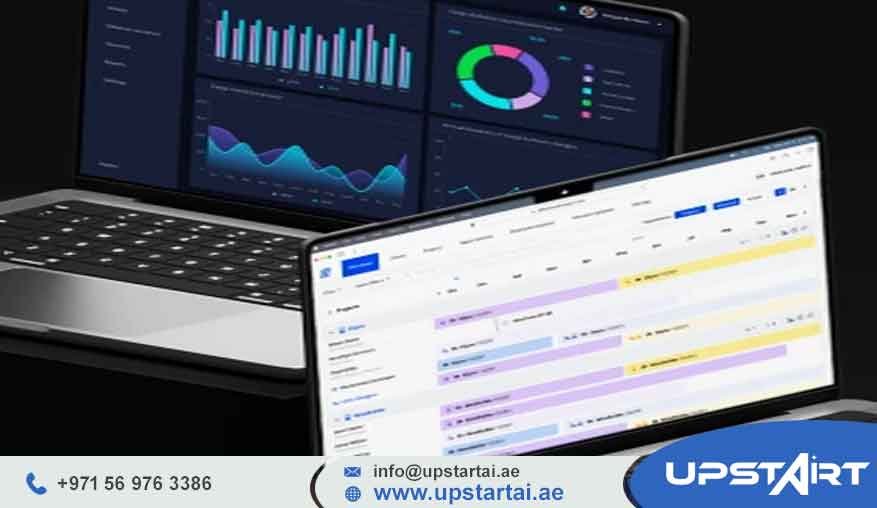
Easy Dashboards: See your fuel costs, delivery times, and warehouse space on one screen.
We Know the UAE: Our systems work in both English and Arabic and handle local customs easily.
Why Choose UpstartAI for Your Logistics ERP?
Picking the right partner for your digital shift is a big deal. UpstartAI has become a top choice for ERP for logistics service providers in the UAE because we actually live and work here. We get the local pressures. Whether it’s the tough requirements for ERP for cold chain logistics in the summer heat or the “need it now” speed of ERP for eCommerce logistics, our team has the local “know-how” that big global companies often miss. We take data privacy very seriously, making sure your shipping secrets and client lists are locked up tight with top-level encryption that follows UAE data laws.
We really care about getting you up and running quickly and staying by your side afterward. In this business, even one hour of being “down” means losing money and unhappy customers. That’s why UpstartAI has a support team ready 24/7 across all the Emirates. We want to make sure your logistics management ERP is always working hard for you. We mix smart AI tech with a friendly, human touch to help your leaders stop guessing and start making moves based on real facts.
Our Comprehensive Logistics ERP Services
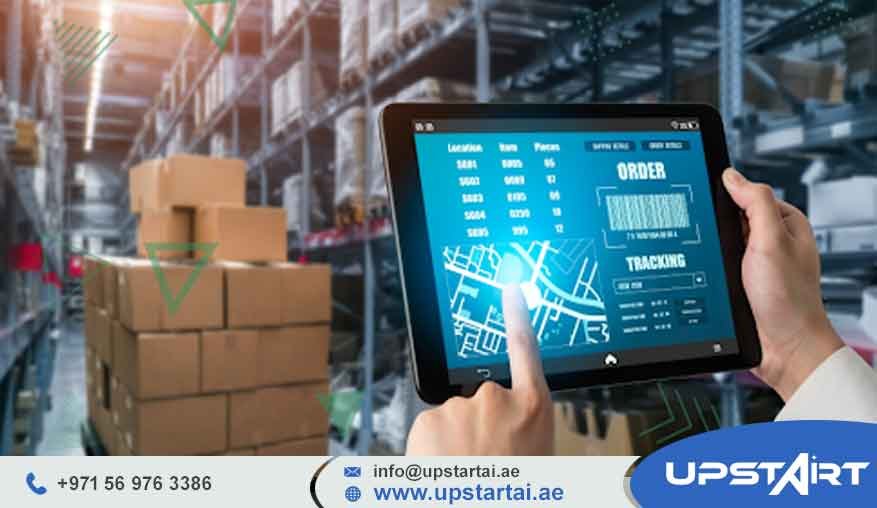
At UpstartAI, we’ve built a bunch of different modules meant for the transport and supply chain world. Our logistics ERP with inventory management lets you check your stock across different free zone warehouses in real-time. This helps stop those annoying UAE problems like having too much stock or running out right when a customer calls. For the teams on the move, our logistics ERP with fleet tracking links up with GPS to watch fuel use, how your drivers are doing, and if the trucks need a service.
It’s more than just simple tracking, though. We give you an ERP with supply chain visibility that connects your suppliers, drivers, and customers in one place. Our logistics ERP with billing and invoicing is already set up for UAE e-invoicing standards, so your paperwork is automated and your VAT is always correct without you having to stress. From ERP for last-mile delivery companies that need the best routes to ERP for international logistics companies handling tricky customs forms, UpstartAI has the right tools to grow as you do.
The UpstartAI Implementation Process
Our logistics ERP implementation process is very straightforward. We start with a Discovery Call just to chat and hear about where your business is getting stuck. Then we do KPI Mapping, where we figure out which numbers actually make you money. After that, we do a Data Source Audit to make sure your old files or Excel sheets are clean and ready to move into the new system.
When the boring stuff is done, we start the Integration and Dashboard Build. This is where UpstartAI experts link your warehouse and transport software into one easy home. After we test everything to make sure it’s perfect, we provide Training for your team. We want to make sure everyone feels comfortable using it. The Handover is just the start; we keep helping you with Ongoing Optimization so your system stays smart as the UAE market keeps changing.
Critical Issues We Fix
A lot of logistics companies in Dubai and Sharjah have “blind spots” because they rely on manual Excel reporting. If it takes days to finish a report, the info is already old by the time you read it. UpstartAI fixes this with reporting automation. We give you one “source of truth” so every department is looking at the same numbers. We also fix siloed data, which is when the warehouse and the sales office are seeing different stock levels-that always leads to mistakes.
Our logistics ERP with real-time shipment tracking helps stop delayed decision-making. You don’t have to wait for a driver to answer their phone; you get an alert if there’s a delay so you can tell the customer first. We also clean up messy data by connecting different tools like your CRM and your accounting. With UpstartAI, you can finally see which branch or region is making the most profit and where you’re wasting money on fuel or extra labor.
Transparent Pricing & Cost Insights
Trying to figure out logistics ERP software pricing can be a bit of a headache. At UpstartAI, we try to keep it simple. The cost mostly depends on how big your operation is. Things that change the price are how many systems we need to connect (like Dubai Trade or your GPS) and how many people will be using it.
For a smaller UAE business, a simple logistics ERP with order tracking might cost between For big companies that need a custom ERP for logistics companies with all the bells and whistles for international freight, it usually goes. These are just estimates, of course, but we give you a clear quote after our first check so you know exactly what the ROI will look like.
Expert Advice for Logistics Digitalization
Before you go looking for the best ERP for logistics companies, you should get your house in order. Start by picking your most important numbers-is it “Delivery Cost” or maybe “Warehouse Accuracy”? Once you know what matters, make sure your data is easy to get to. Old paper records are the biggest thing that slows down a logistics ERP implementation.
A good tip for getting your team to use the new system is to focus on a few key things first. Don’t try to do everything at once. Focus on the 5 things that really change your business. UpstartAI also says you should have clear rules on who can see which data to keep things safe. Lastly, always think about the future. The UAE is growing fast, so pick a cloud ERP for logistics that can handle way more orders next year without breaking.
Why UpstartAI is Number 1 in the UAE
People call us the top logistics ERP software providers here because we focus on AI. While other softwares just tell you what happened yesterday, UpstartAI helps you see what might happen tomorrow. We also make sure our screens are easy to look at—drivers and warehouse workers actually like using our system. We also really understand how business works in the UAE.
Our system is built for scalable analytics, so it grows as you add more trucks or move into places like Saudi or Oman. We don’t just give you a password and leave; we provide post-launch support with regular check-ups. By focusing on less manual work and better visibility for bosses, we help UAE logistics leaders get their time back and make choices they feel good about.
Success Stories: Real Results
Dubai 3PL Company: A mid-sized company was having a hard time because their inventory numbers were wrong by 15%. After using UpstartAI’s logistics ERP with warehouse management system, they got to 99.8% accuracy. They also went from taking 5 days to finish reports to just 2 hours.
Abu Dhabi Delivery Firm: This team was worried about high fuel prices. They used our ERP with logistics automation to find better routes. They saved 12% on fuel and their drivers were more on time, which made their customers much happier.
Freight Forwarder: Working between JAFZA and Europe, this client used our ERP for freight transportation companies to handle customs. They cleared customs 30% faster and stopped getting fines because the billing was finally automated.
FAQs – ERP for Logistics
1. What is ERP for Logistics and how does it work?
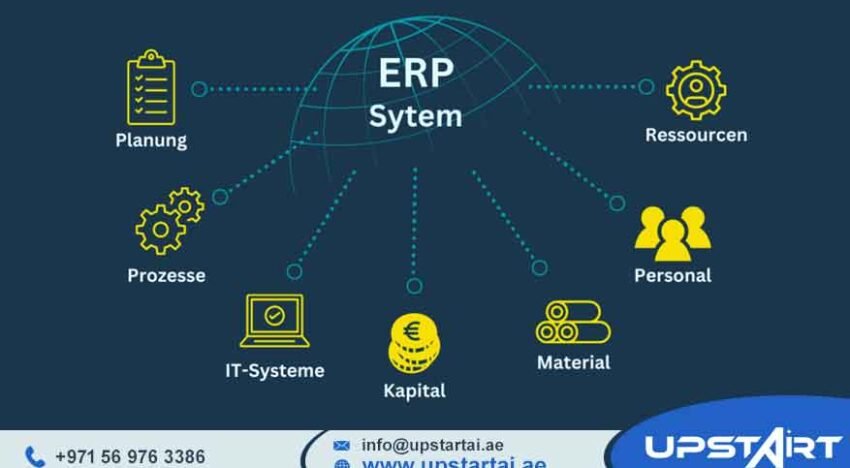
ERP (Enterprise Resource Planning) for Logistics is a centralized software system designed to manage transportation, warehousing, inventory, procurement, finance, fleet management, and supply chain operations within one integrated platform.
It works by connecting all logistics processes into a unified database, enabling real-time tracking, automation, and reporting.
How it works:
-
Integrates warehouse, fleet, finance, and HR systems
-
Tracks shipments in real time
-
Automates order processing and invoicing
-
Provides dashboards for performance monitoring
Example:
A logistics company using ERP can:
-
Track delivery vehicles live
-
Automatically update shipment status
-
Generate invoices immediately after delivery
-
Monitor fuel and maintenance costs
2. What are the key benefits of ERP in logistics companies?
ERP helps logistics businesses streamline operations and reduce inefficiencies.
Major benefits include:
-
Real-time shipment tracking
-
Automated inventory management
-
Optimized route planning
-
Reduced operational costs
-
Better customer communication
-
Improved financial transparency
Example:
An ERP system can alert managers if a shipment is delayed, allowing proactive customer updates and route adjustments.
3. How does ERP improve supply chain management?
ERP enhances supply chain visibility and coordination between suppliers, warehouses, and customers.
It improves supply chain management by:
-
Providing end-to-end shipment tracking
-
Managing supplier contracts and performance
-
Automating purchase orders
-
Monitoring warehouse stock levels
-
Forecasting demand trends
Example:
If stock levels drop below a predefined threshold, ERP can automatically generate a purchase order to prevent supply shortages.
4. What modules are included in a Logistics ERP system?
Logistics ERP systems are modular and customizable.
Common modules include:
-
Warehouse Management
-
Inventory tracking
-
Barcode/RFID integration
-
Stock movement monitoring
-
-
Transportation Management
-
Route optimization
-
Fleet tracking
-
Delivery scheduling
-
-
Fleet Management
-
Vehicle maintenance tracking
-
Fuel monitoring
-
Driver performance reports
-
5. Is ERP suitable for small logistics companies?
Yes, ERP solutions are scalable and can be customized for:
-
Small courier services
-
Freight forwarding companies
-
Warehouse operators
-
Large multinational logistics enterprises
Example:
-
A small courier company may use ERP mainly for tracking deliveries and invoicing.
-
A large logistics firm may implement advanced modules for AI-based route optimization and predictive analytics.
Cloud ERP makes implementation affordable for smaller businesses.
6. How does ERP improve fleet management?
ERP provides complete visibility into vehicle operations.
ERP improves fleet management by:
-
Tracking vehicle locations in real time
-
Monitoring fuel usage
-
Scheduling preventive maintenance
-
Recording driver performance
-
Reducing downtime
Example:
If a vehicle is due for servicing, ERP can automatically notify the maintenance team, preventing unexpected breakdowns.
7. What is the difference between Logistics ERP and Transportation Management System (TMS)?
While both systems support logistics operations, they serve different purposes.
Transportation Management System (TMS):
-
Focuses mainly on shipment planning and freight management
-
Optimizes routes and manages carriers
Logistics ERP:
-
Covers the entire business ecosystem
-
Integrates finance, HR, warehouse, procurement, and transportation
-
Provides enterprise-level reporting and analytics
In simple terms:
TMS manages transportation.
ERP manages the entire logistics business.
8. How does ERP reduce logistics costs?
ERP minimizes operational waste and improves cost control.
Cost-saving features include:
-
Optimized route planning to reduce fuel costs
-
Reduced inventory holding costs
-
Automated billing to prevent revenue leakage
-
Real-time expense monitoring
-
Improved supplier negotiations
Example:
Route optimization through ERP can reduce fuel consumption by identifying the shortest or least congested paths.
9. What challenges should companies consider before implementing ERP for logistics?
Implementation requires strategic planning.
Common challenges include:
-
Initial investment costs
-
Data migration from legacy systems
-
Employee training
-
Integration with GPS and IoT devices
-
Change management
Best practices:
-
Conduct operational analysis before implementation
-
Choose a scalable ERP solution
-
Train staff properly
-
Implement in phases
10. What is the ROI of ERP for Logistics?
The return on investment (ROI) comes from operational efficiency and improved profitability.
ERP ROI includes:
-
Faster order processing
-
Reduced delivery delays
-
Improved customer satisfaction
-
Lower fuel and maintenance costs
-
Better financial forecasting
Logistics companies often experience long-term efficiency gains and stronger competitive positioning.
Ready to Fix Your Logistics?
Don’t let old, slow systems stop you from growing in such a busy place. UpstartAI is here to give you the control you need to lead the UAE market. Whether you’re in Dubai, Abu Dhabi, Sharjah, Ajman, Ras Al Khaimah, Fujairah, or Umm Al Quwain, we are ready to help out.
Come see what a real ERP for Logistics can do for you. Give us a shout today and let’s get started.
[Get Your Free Logistics ERP Assessment Now]