Switching to a modern digital core is probably the biggest move any Middle Eastern conglomerate can make today. We live in a time where data is basically currency. Because of that, a solid ERP Implementation Timeline isn’t just a calendar on a wall—it is your master plan for staying competitive and growing across the region. If you are running an enterprise in the DIFC, Abu Dhabi, or any of the Northern Emirates, the stakes are massive. You have to balance strict local regulations with the need for speed, and you have to do it perfectly.
The goal here is to speed up your digital shift using a data-driven strategy that actually fits Dubai’s high-pressure market and the GCC’s unique economy. We don’t look at technical infrastructure as just a “tool.” We see it as a growth engine designed to help you beat global competitors.
Schedule a Free Call Today
Certified Experts | UAE-Wide Clients | ROI-Focused Campaigns | 10+ Years Experience
Expert Architects of Your Business Transformation Strategy
If you want a large-scale software move to work in the UAE, ERP Implementation Timeline, everything depends on the strategy you start with. At UpstartAI, we take a “Business-First” approach. This means we make sure the technology supports your commercial goals instead of making things more complicated. The truth is, many local companies never see a real return on their investment. Why? Because they get distracted by flashy software features and forget about actual business results. We fix that by matching your digital core to the real-world economy of the Gulf—from the busy Jebel Ali docks to the huge real estate firms in Abu Dhabi.
Smart design is really what separates a market leader from a company that’s just stuck. Think about it: a multinational based in the Dubai International Financial Centre needs something completely different than a factory in Ras Al Khaimah. We focus on cutting out “feature bloat.” This is a common trap where businesses end up paying for expensive tools they will never use. Instead, we focus on things that actually matter—like smart procurement, automatic VAT filing, and live cash-flow tracking. These are the things that give the C-suite and shareholders immediate value.
By 2026, “Sovereign Intelligence” has become a must-have for UAE businesses. Your data has to be more than just “secure”—it has to follow local laws like the Dubai Electronic Security Center (DESC) standards. UpstartAI specializes in setting up frameworks that keep your sensitive data right here on-shore, while still using the power of global cloud tech. This gives you a foundation that is as safe as a vault but fast enough to keep up with Dubai’s pace.
AI-Enhanced Resource Planning
Today, managing resources takes more than just a dusty database. By putting predictive analytics into your core system, we can spot and stop the delays that usually mess up an ERP Implementation Schedule. Our AI models look at your past data to guess where supply chain hiccups or resource shortages might happen. This lets your management team fix things before they turn into a real problem for the project.
Deep UAE Regulatory Expertise (VAT & WPS)
Keeping up with the Federal Tax Authority (FTA) is a top priority for every CFO in this region. We build our implementations with these local rules right at the center. We automate your tax audit files and make sure everything stays in sync with the Wage Protection System (Siyagh). This takes the manual workload off your HR and finance teams. Having this local focus stops the legal headaches that usually come from using generic, “one-size-fits-all” international software.
Cross-Emirate Scalability
Expanding across the UAE means your system needs to handle different local rules without a hitch. Whether you are managing property in Sharjah or running industrial plants in Umm Al Khaimah, our setup gives you a single view of your entire business. This “one source of truth” lets you make central decisions while still giving your local offices the freedom they need to operate.
Navigating the Full ERP Implementation Lifecycle in 2026
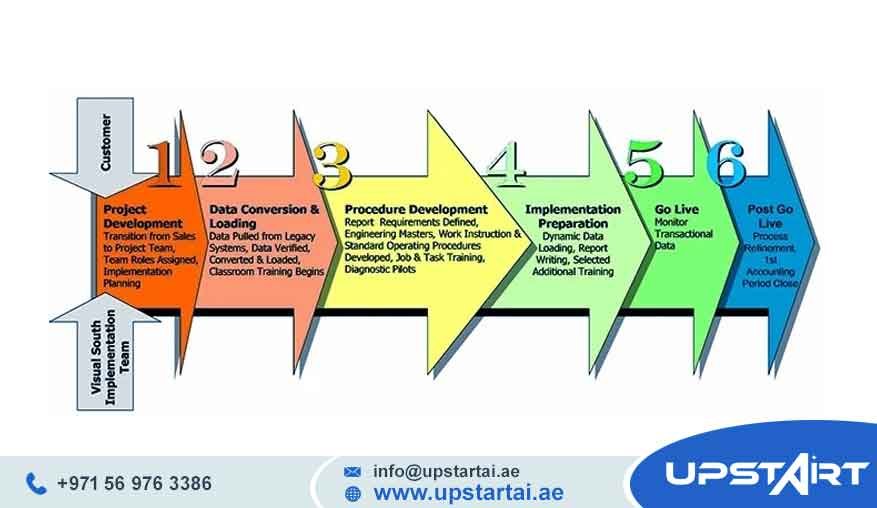
The ERP Implementation Lifecycle is a long journey with many stages. It takes a mix of technical skill and knowing how to manage people through big changes. We start with a “forensic” audit of how your company actually runs today. We hunt for “shadow IT”—all those unofficial spreadsheets and random tools that keep the lights on but keep your data hidden away. By finding these gaps early, we can figure out if you can use a ready-made solution or if you need something custom-built to keep your edge.
After we finish the discovery phase, we move into design and customization. This is where we shape the digital core to match your company’s DNA. For a luxury shop in Dubai, that might mean focusing on the customer experience and tracking inventory across different malls in real-time. For a construction company in Abu Dhabi, it’s all about managing the project lifecycle and subcontractor costs. This stage makes sure the software is an asset that helps you work your way, not a cage that forces you to change.
Moving your data and testing it is the most delicate part of the whole process. Shifting years of history from old systems into a modern AI core takes total accuracy. We use advanced ETL (Extract, Transform, Load) tools to clean up your data before it ever touches the new system. Then comes the serious User Acceptance Testing (UAT). This is where your team makes sure every workflow does exactly what it’s supposed to do. This careful approach makes the final switch smooth and keeps your data flowing perfectly.
Phase 1: Discovery and Gap Analysis
Our team dives deep into your daily work, talking to everyone from the people in the warehouse to the executives in the boardroom. This phase finds the exact spots where your operations are losing time or money. We don’t just look at the code; we look at the people and the processes that keep your business moving in Dubai and across the region.
Phase 2: System Design and Modular Customization
In this part of the project, we map out the technical needs for your long-term goals. We prioritize “modular” integration, which means we can plug in high-tech AI tools without breaking the things that already work. This keeps your ERP Implementation Timeline on schedule while giving you a system that feels like it was made just for you.
Phase 3: Data Migration and User Acceptance Testing (UAT)
Being precise is everything here. We manage the secure move of your enterprise data, making sure every single record is accounted for and formatted the right way. Our UAT sessions are built to “stress test” the system in a safe environment. This ensures that when you finally go live, the platform is steady and easy for your team in Sharjah to use.
Phase 4: Training and Post-Launch Hyper-care
At the end of the day, a system is only as good as the people using it. We provide deep training programs for different roles, making sure everyone feels ready. Our “hyper-care” period offers 24/7 support right after launch. We fix any small bugs instantly so your business doesn’t miss a beat in the competitive UAE market.
Our Proven ERP Implementation Schedule for Rapid ROI
In the UAE business world, time is literally money. A late launch doesn’t just mean more development fees; it means lost chances and wasted effort. UpstartAI uses a fast-moving ERP Implementation Schedule that delivers value in stages. You don’t have to wait a year for a single “big bang” rollout. We turn on the most important parts first—like finance and HR—so you can start seeing the benefits of better data almost immediately.
This phased approach also helps your people handle the change. Moving to a new system is a big shock for any company. By changing things slowly, your staff has time to get used to it and tell us what’s working. We then use that feedback to tune the more complex parts of the system. This stops employees from “rejecting” the tech and ensures it’s actually used. We take your timeline as seriously as a major skyscraper project in Downtown Dubai.
Our plan is built on being open and accountable. We give you a real-time dashboard so you can see exactly where the project stands compared to the ERP Project Planning Timeline. You’ll see every milestone and every potential risk before it turns into a problem. This level of clarity is vital for leaders who need to show the board and shareholders exactly how their digital investment is paying off.
Step 1: Forensic Business Audit
We start by finding the specific ERP Implementation Steps that will give you the biggest win. This audit goes deep, looking at how data travels between your Abu Dhabi office and your partners around the world. We look for the hidden inefficiencies that, once fixed, will actually pay for the whole system.
Step 2: Agile Development & Integration
Our engineers work in quick, intense “sprints” to build the modules you need most. Whether it’s a logistics tool for Jebel Ali or a billing system for a DIFC law firm, we weave these into the ERP Rollout Timeline without causing hold-ups. This keeps the project moving and the quality high.
Step 3: Seamless Go-Live & Scaling
The final switch is handled with extreme care. We coordinate the move from your old system to the new core, usually during off-hours to avoid any downtime. Once you’re live, we focus on rolling the system out to your other UAE offices, making sure your growth is backed by a rock-solid digital foundation.
Specialized Expertise Across the Business Software Journey
By 2026, the world of business software is more diverse than it’s ever been. You have to choose between big global platforms, local custom builds, or a mix of both. UpstartAI guides you through the whole ERP Implementation Lifecycle, explaining the pros and cons of every choice. For many UAE companies, a hybrid model is the winner—you get the stability of a giant like SAP or Oracle, plus custom AI tools made specifically for the Middle East.
If you are a global conglomerate with massive needs, we have the skills to handle those Tier 1 systems. These platforms have a million features, but they need an expert hand to make sure they are set up correctly for the GCC. We focus on “localizing” these giants so they understand UAE trade, VAT, and labor laws. This stops the common problem where a multi-million dollar system fails just because it didn’t understand how things work here.
On the flip side, we offer Custom AI-Driven Development for companies that want a real edge. This means building a system from scratch that perfectly fits your business. This is the best path for luxury real estate, shipping, or government-linked firms where “standard” software isn’t enough. Our custom builds follow DESC rules and sit on local UAE servers, giving you the best security and speed possible.
Tier 1 Enterprise Solutions (SAP, Oracle, Microsoft Dynamics)
We take the headache out of using world-class platforms. Our team makes sure your global ERP fits your local needs perfectly, managing the whole ERP Deployment Process with a focus on regional rules. We act as your advocate with software companies to make sure you’re getting every bit of value from your licenses.
Custom AI-Driven ERP Development
For companies that want to lead the pack, we build custom engines for growth. Our code is clean, modern, and built to last. We put “Agentic AI” right into the core, creating a system that doesn’t just store your data but actively finds ways to improve your business in Dubai and Fujairah.
Cloud-Native vs. Hybrid Deployment Options
Deciding where your system “lives” is a huge strategic move. We help you find the balance between the flexibility of the cloud and the control of having your own servers. For many industrial firms in RAK or Ajman, a hybrid model is the best way to keep things running 24/7 without any interruptions.
Meeting Critical Project Goals to Prevent Operational Drift
One of the biggest risks in tech is “operational drift”—this is when a project loses focus and starts going over budget or past the deadline. We stop this by sticking to a very strict ERP Project Planning Timeline that is tied to real business goals. Every goal we reach is a step toward solving a real problem, like cutting out manual data entry or making your supply chain faster.
The “Excel Nightmare” is a real thing for many UAE businesses. Having data stuck in different spreadsheets leads to mistakes, delays, and a total lack of clarity. Our job is to pull those pieces together into one unified system. This transparency is a lifesaver for an executive in Abu Dhabi who needs to know exactly what is happening in a Sharjah warehouse right now. By automating data flow, we kill the bottlenecks that slow down growth.
People often forget about lead quality and marketing ROI when talking about ERPs. But a truly integrated system links your sales and marketing data directly to your finances. This lets you see the whole journey, from a customer clicking an ad in Dubai to paying their final invoice in Fujairah. When you know which leads make the most money, you can spend your marketing budget much more wisely.
Ending the “Excel Nightmare”
Manual data entry is what kills a company’s ability to scale. Our process follows a tight ERP Deployment Process that automates how info is collected. This cuts out human error and lets your team focus on the high-value work that actually helps your business grow.
Real-Time Visibility into Multi-Emirate Cash Flow
Knowing your exact money situation at any moment is like having a superpower. Our systems give you live dashboards that track every Dirham across the whole company. This makes managing your cash easier and helps you make faster decisions so you can jump on new opportunities in the GCC.
Compliance and Audit Readiness
In the UAE, an audit shouldn’t be scary. Our systems keep a perfect, unchangeable record of every single transaction. You’ll always be ready for an FTA check. We automate the tax audit files, making the whole process a “non-event” for your finance team.
Budgeting for Your Investment: CapEx vs. OpEx
The true cost of a new system is often misunderstood. When you look at the ERP Implementation Timeline, the price tag is only one part of it. CFOs have to choose between a CapEx model (where you own the asset) and an OpEx model (where you pay a monthly fee). UpstartAI provides clear financial maps to help you pick the path that’s best for your balance sheet.
Custom builds might look more expensive at first, but over 10 years, they are often much cheaper than “Ready-Made” software. Why? Because you don’t have to pay monthly fees for every single user, and you own the roadmap. For a big firm with thousands of people in Dubai and Abu Dhabi, those licensing savings add up fast. We help you look past the initial price to see the Total Cost of Ownership (TCO).
Beyond the software, you have to think about training, moving data, and long-term support. We are 100% open about these “hidden” costs from the start. Our ERP Implementation Steps include a full budget breakdown so there are no surprises halfway through. We respect your budget as much as our own, focusing on getting you the best ROI for every Dirham you spend.
Understanding Total Cost of Ownership (TCO)
A smart move requires looking at the costs from every angle. We help you factor in things like server upkeep and future upgrades. When you understand the TCO, you can make a multi-million Dirham decision with zero doubt, knowing your board is fully on your side.
ROI Projections and Break-Even Analysis
How long until the system pays for itself? We give you detailed guesses based on labor savings and efficiency gains. For many UAE companies, a solid ERP Implementation Timeline pays for itself in 18 to 24 months, giving your long-term profits a massive boost.
Expert Advice for a Flawless Transition in 2026
Enterprise tech is moving faster than ever. In 2026, the focus has moved from simple automation to “Agentic AI.” These are smart agents that can actually make decisions—like negotiating with a supplier when you’re low on stock or spotting a tax error before you send an invoice. Putting these tools into your ERP Rollout Timeline isn’t a luxury anymore; it’s what you need to stay competitive in a place like Dubai.
Being mobile is another huge deal. Executives in the Gulf are always moving between sites in the Northern Emirates or traveling abroad. Your system has to be “Mobile-First,” giving you a smooth experience on a phone or tablet without risking security. If you can’t manage your business from your phone, your system is outdated. We build high-performance apps that put you in total control, wherever you are.
Lastly, don’t ignore the importance of local support. A global software giant might have a cool platform, but if their support team is in a different time zone and doesn’t know UAE labor laws, you’re in trouble. UpstartAI offers 24/7 help right from our Dubai office. You get to talk to the engineers who actually built your system. This local connection is your best shield against downtime.
The Rise of Agentic AI in ERP Workflows
Autonomous agents are the next big thing for productivity. We build these right into your system so they can handle the boring, repetitive stuff that drains your team’s energy. Moving from “data entry” to “decision making” is the biggest jump in efficiency we’ve seen in years.
Prioritizing Mobile-First Accessibility
We design for the executive on the go. Our interfaces are clean and lightning-fast on any device. Whether you are in a boardroom in Abu Dhabi or at a shipping terminal in Fujairah, you’ll have live data and powerful tools right in your pocket.
The UAE Leader in Managing Enterprise Systems
UpstartAI has become the top name for digital shifts in the Emirates because we combine the depth of a massive consultancy with the speed of a startup. We don’t just sell software; we deliver results. Our 100% success rate comes from being totally honest and technically excellent. When you work with us, you get a team that cares as much about your growth as you do.
Our skills come from a decade of helping GCC businesses overcome their unique hurdles. We know the local power grids, the business culture, and the strict rules of UAE government bodies. This “Emirates-First” focus means we care about what you care about: security, compliance, and fast growth. We are proud to help UAE companies become global leaders.
We’d love for you to see what a specialized partner can do. Our senior architects love tackling the hardest problems in the industry. We don’t use annoying jargon or hide behind confusing contracts. We give you straight, honest advice that helps your team win. In the fast-paced world of 2026 Dubai, you need an ERP Implementation Timeline that is built for speed and engineered for success.
10+ Years of GCC Market Mastery
We’ve been working with UAE businesses for over 10 years. We know what works and, just as importantly, what doesn’t. Our deep regional knowledge lets us see problems coming, making sure your project stays on time and on budget.
Local Support, Global Standards
Our Dubai team is always just a phone call away. We combine this local presence with the best global practices in engineering and management. You get a partner who is right here with you, but who builds everything to a world-class standard.
Case Study: Achieving Rapid ERP Project Milestones in Fujairah
A major logistics firm in Fujairah hit a wall as they grew globally. Their old systems couldn’t handle complex multi-currency billing or track ships across the world. This led to huge delays in getting paid and no clear idea of their actual costs. They were growing, but their technology was dragging them down.
UpstartAI moved in to design a custom ERP Rollout Timeline. We chose a hybrid path, adding a custom ship-tracking module to a solid financial core. The results were instant: billing delays dropped by 30%, overall efficiency went up by 15%, and revenue grew by 40% in just six months. By hitting every one of their ERP Project Milestones on time, we helped this UAE leader reach a whole new level.
Your Guide to the ERP Implementation Schedule and Deployment
How long is the average ERP Implementation Timeline for a UAE business?
Every project is different, but a typical enterprise-level move takes between 6 to 14 months. It depends on how messy your data is, how much customization you need, and how fast your team can learn. Our agile method focuses on getting the first working parts live in the first 90 days so you see a return on investment quickly.
What factors can delay our ERP Go-Live Timeline?
The biggest delays usually come from messy data in old systems or not having clear goals from the start. To stop this, we focus on a deep discovery phase and a very organized ERP Deployment Process. Making sure your data is clean and your leaders are all on the same page from Day 1 is the best way to keep the launch on track.
How do you define the most critical ERP Project Milestones?
Key milestones usually include finishing the initial audit, finalizing the system design, moving 100% of the data, and getting the final “thumbs up” from your team during testing. Think of these as gates that have to be passed before we move forward. This ensures every one of the ERP Implementation Steps is built on a solid foundation.
Why is a customized ERP Implementation Strategy better than a standard one?
A “standard” strategy assumes every business is the same, which just isn’t true in a place like the UAE. A custom strategy looks at your specific advantages, local laws, and how your team actually works. It makes sure the system fits your business, rather than forcing you to change how you work to fit the software.
What are the risks of a rushed ERP Go-Live Timeline?
Rushing a launch usually leads to bad data, confused employees, and system bugs. This can cause a huge mess and hurt your reputation with clients and suppliers. We believe in a “steady is fast” approach, where we test and double-check every part of the ERP Rollout Timeline before moving to the next stage.
Can we update our ERP Implementation Schedule mid-project?
Yes. Our agile method is built to be flexible. If your business changes or a new law comes out while we are working, we can shift the ERP Implementation Schedule to match. This ensures the final product fits your current situation, even in a market as fast as Dubai.
Start Your ERP Implementation Timeline with UpstartAI Today
The system you choose next will set the pace for your business for the next ten years. In a world that values speed, data, and AI, your digital core is what decides if you lead the market or just follow it. UpstartAI has the technical skills and local knowledge to make sure your ERP Implementation Timeline is a massive success, turning your tech into an engine for growth across the UAE and the GCC.
Staying still is much more expensive than modernizing. Every day you spend fighting with old data and manual work is a day your competitors move further ahead. In the fast world of 2026, the chance to truly transform is moving fast; the best time to build your foundation is right now.
UpstartAI Offices: Dubai (HQ), Abu Dhabi, Sharjah, Ajman, RAK, Fujairah, Umm Al Quwain.
Phone: +971 569763386
Email: info@upstartai.ae
Website: www.upstartai.ae