In the sophisticated economic landscape of the GCC, the fragmentation of corporate data acts as a friction tax on every executive decision. At UpstartAI, we recognize that true digital transformation is not merely about adopting a software suite; it is about the orchestration of high-fidelity information across every department. Adhering to rigorous ERP Integration Best Practices is the only way for Dubai-based enterprises to ensure that their financial, logistics, and human resource modules operate as a single, cohesive organism. By architecting a unified digital core, we empower regional leaders to move beyond manual reconciliation and toward a future of autonomous, real-time business intelligence.
Establishing a robust connection between your legacy infrastructure and modern cloud applications requires more than technical skill—it requires a strategic vision that respects the local regulatory environment. Whether your organization is navigating the complex VAT requirements of the Federal Tax Authority or managing intricate supply chains across the Northern Emirates, your integration must be resilient. The truth is, we bridge the gap between ambitious business objectives and technical execution. We provide the architectural backbone necessary for sustainable growth in the 2026 UAE market.
Think of it this way: your business is only as fast as its slowest data silo. We help you break those walls down so information flows where it’s needed, when it’s needed. This isn’t just about code; it’s about making sure a CEO in Dubai and a warehouse manager in Sharjah are looking at the exact same numbers. By focusing on these core principles, we help you build a system that doesn’t just store data but actually uses it to drive your company forward.
Schedule a Free Call Today. Certified Experts | UAE-Wide Clients | ROI-Focused Campaigns | 10+ Years Experience
Why Choose UpstartAI for ERP System Integration Strategies
Selecting the appropriate technical roadmap for your organization is a decision that dictates your operational agility for the next decade. At UpstartAI, our ERP system integration strategies are built on the principle of “Interoperability by Design.” We avoid the pitfalls of fragile, point-to-point connections that often break during software updates. Instead, we architect flexible environments that utilize modern middleware and robust API gateways. This ensures that as your business scales from a Dubai startup to an Abu Dhabi conglomerate, your tech stack scales with you.
In the high-stakes environment of the DIFC and ADGM, data latency can result in millions of dirhams in missed opportunities. Our consultancy-first approach begins with a deep-tier audit of your existing technical debt and organizational workflows. We don’t just connect software; we align your ERP system integration strategies with your specific commercial goals. This might mean shortening financial close cycles or improving the accuracy of procurement forecasts. This strategic alignment ensures that your technical investment translates directly into a quantifiable competitive advantage.
The reality is that most IT projects fail because they ignore the human element. We focus on creating unified data dashboards that present a “Single Source of Truth,” eliminating the conflicting reports that often plague large-scale organizations in Sharjah and Ajman. By working with UpstartAI, you are choosing a partner that values precision, security, and long-term scalability above all else. We make sure your digital core remains an asset rather than a liability that holds you back.
Advanced ERP Integration Solutions for Modern Companies
The modern enterprise is a constellation of specialized SaaS tools, legacy databases, and proprietary applications. Our ERP integration solutions are designed to harmonize these disparate elements into a high-performance ecosystem. We specialize in complex, multi-point orchestrations that allow data to flow naturally between your central ERP and auxiliary systems like CRM, E-commerce, and HRIS. This holistic connectivity is essential for UAE firms looking to automate repetitive tasks and reduce the risk of human error in their data entry processes.
Security and data residency are non-negotiable pillars of our implementation model. Given the UAE’s strict data protection laws, we ensure that all ERP integration solutions are deployed using secure, localized cloud environments such as Moro Hub or G42. We implement enterprise-grade encryption and zero-trust security protocols at every integration point. This protects your sensitive corporate intelligence from external threats while allowing your team to collaborate across the seven Emirates without compromising data integrity.
In the real world, it’s about workflow orchestration, not just syncing files. This means an action in your sales portal in Ras Al Khaimah can automatically trigger a procurement order in your Jebel Ali warehouse. It also updates your financial ledger in Dubai simultaneously. Our ERP integration solutions eliminate the “Swivel-Chair Effect,” where employees are forced to manually copy data between systems. By automating these cross-functional processes, we free your talent to focus on high-value strategic initiatives that drive revenue and improve customer satisfaction.
Strategic ERP Data Integration and Governance
At the heart of every successful connectivity project lies the quality of the information being shared. Our approach to ERP data integration prioritizes hygiene and structural integrity above all else. We utilize advanced ETL (Extract, Transform, Load) processes to ensure that information is cleaned and standardized before it reaches your central repository. This is particularly critical for UAE organizations managing multi-currency transactions or complex VAT calculations under the FTA, where a single data error can lead to significant compliance risks.
Enterprise System Integration ERP Frameworks
Building a resilient digital backbone requires a standardized methodology that can withstand the test of time. We deploy sophisticated enterprise system integration ERP frameworks that act as the central nervous system of your business. These frameworks utilize service-oriented architectures (SOA) or microservices to ensure that individual modules can be updated or replaced without disrupting the entire system. This modularity is vital for UAE firms that need to stay agile in a rapidly evolving global market.
High-Security ERP API Integration Methods
The modern way to connect enterprise software is through high-performance programming interfaces. We specialize in ERP API integration techniques that allow for real-time, bi-directional communication between your core system and third-party services. Whether you are connecting to a UAE government portal for employee visa processing or integrating a specialized logistics platform, our API-first approach ensures that the connection is secure and highly performant. This provides a stable foundation for your digital operations.
The Core Components of an ERP Integration Framework
A successful implementation is built on a foundation of technical rigor and clear governance. Our proprietary ERP integration framework is designed to handle the massive volumes of data generated by modern Middle Eastern enterprises. We break the process down into distinct technical layers, starting with the “Transport Layer” which ensures secure data movement. We follow this with the “Transformation Layer” which aligns different data formats, and finally the “Orchestration Layer” which manages the logic of how and when data should move between systems.
Connectivity & Transport: Utilizing secure protocols (HTTPS, SFTP) to move data between endpoints safely.
Mapping & Transformation: Converting XML, JSON, or EDI formats into a unified schema that your ERP actually understands.
Process Orchestration: Defining the business rules that trigger data movement based on specific events or schedules.
Error Handling & Logging: Implementing real-time alerts to ensure any synchronization failures are identified and resolved instantly.
By following this structured ERP integration framework, we minimize the risk of system crashes and data corruption. We also place a heavy emphasis on “Idempotency.” This ensures that the same data is never processed twice, which prevents the duplication of invoices or inventory records. For a logistics firm operating in the Port of Fujairah or a retail chain with hundreds of outlets across the UAE, this level of technical precision is the difference between a smooth operation and an administrative nightmare.
Think of this framework as the rulebook for your data. Without it, things get messy fast. We make sure every bit of information has a clear path and a specific purpose. This leads to a system that is not only faster but much easier to manage over the long term. In the end, you get a digital backbone that supports your growth instead of getting in the way.
Deployment Roadmap: Applying ERP Integration Best Practices
Achieving a state of total system harmony requires a disciplined, phased approach that prioritizes stability. We implement ERP Integration Best Practices by first conducting a “Connectivity Discovery” phase. Here, we map out every digital touchpoint in your organization. This allows us to identify potential bottlenecks and security vulnerabilities before a single line of code is written. We believe that 80% of the success of an integration project is determined in the planning phase, which is why our architects spend significant time ensuring the logic is flawless.
In the second phase, we focus on “Agile Execution.” We build and test each integration point in an isolated environment. This ensures that the connection is resilient to edge cases and high traffic volumes. By adhering to ERP Integration Best Practices, we ensure that your system can handle the “Ramadan Peak” or end-of-year financial auditing without a dip in performance. We use automated testing suites to simulate thousands of transactions, verifying that your data remains consistent across all connected platforms, from your CRM in Dubai to your manufacturing plant in Umm Al Quwain.
The final phase is “Hyper-Care and Optimization.” Once the integrations are live, we monitor the data flows in real-time, fine-tuning the performance and scaling the infrastructure as needed. We also provide intensive training for your internal IT teams to ensure they can manage the day-to-day operations of the new ecosystem. By following these ERP Integration Best Practices, UpstartAI ensures that your digital transformation is not a one-time event, but a sustainable foundation for long-term innovation and regional market leadership.
Critical Problems We Solve via Seamless ERP Integration
The primary challenge facing most UAE enterprises is the “Data Silo” problem, where valuable information is trapped within specific departments. Our goal is to achieve seamless ERP integration that dissolves these barriers. This allows a sales representative in Abu Dhabi to see real-time inventory levels in a Sharjah warehouse without making a single phone call. This level of transparency reduces friction, accelerates the sales cycle, and significantly improves the overall customer experience by providing accurate, up-to-date information at every touchpoint.
Manual data entry is not only slow; it is a major source of financial risk. A single typo in a VAT return or a procurement order can lead to costly errors and regulatory penalties. We achieve seamless ERP integration by automating these data flows. This ensures that information is captured at the source and propagated throughout the organization instantly. This is particularly vital for firms in the Jebel Ali Free Zone, where high-volume international trade requires meticulous documentation and perfect synchronization between shipping, customs, and accounting modules.
Security is another critical pain point that we address through our connectivity models. Disconnected systems often rely on insecure methods of data sharing, such as emailing Excel sheets. We replace these “Shadow IT” practices with a seamless ERP integration that utilizes encrypted API calls and secure middleware. This ensures that your corporate intellectual property and customer data remain protected within your secure digital perimeter. It significantly reduces the risk of a data breach and ensures compliance with the UAE’s increasingly stringent cybersecurity regulations.
Technical Superiority through ERP Connectivity Solutions
In the era of hyper-connectivity, the speed at which your systems communicate determines your market responsiveness. Our ERP connectivity solutions utilize high-bandwidth protocols and low-latency architectures to ensure that your data moves at the speed of business. Whether you are managing real-time IoT sensors in a Dubai smart building or tracking fleet movements across the GCC, our connectivity stack is built to handle the most demanding data environments in the Middle East.
We leverage “Edge Computing” where necessary to process data closer to the source. This reduces the load on your central ERP and improves response times for your field teams. This advanced approach to ERP connectivity solutions is what allows UpstartAI to support the next generation of UAE industrial leaders. We don’t just provide a cable; we provide a high-intelligence nervous system. This allows your entire organization to react to market shifts with unprecedented agility and precision.
Modern ERP Software Integration Methods
The landscape of enterprise tech is shifting away from rigid “Point-to-Point” connections toward more fluid, event-driven architectures. Our integration methodologies utilize webhooks and message brokers to ensure that your systems are always in sync. This event-driven approach is among the most effective ERP software integration methods for firms that require instant updates across multiple global offices. It ensures that a sale in London is reflected in your Dubai ledger within milliseconds.
Implementation Timelines and Integration Costs in the UAE
A common query from C-suite executives involves the time-to-value for a connectivity project. In the UAE market, a standard project following ERP Integration Best Practices typically requires 12 to 24 weeks. This depends on the complexity of the legacy systems and the number of endpoints. We provide a detailed roadmap that includes specific milestones for data mapping, environment setup, and UAT (User Acceptance Testing). This ensures that your stakeholders are aligned on the delivery schedule from day one.
Regarding costs, an enterprise-level integration represents a strategic investment in efficiency. Prices in the Emirates typically range from AED 150,000 for specialized point-to-point connections to AED 800,000+ for full-scale ecosystem orchestration. UpstartAI focuses on ROI by targeting high-impact areas first. This ensures the system begins paying for itself through reduced manual labor and improved data accuracy long before the final module is deployed. We provide transparent, milestone-based pricing that reflects the high-level engineering required.
Case Study: Digital Transformation for a UAE Real Estate Giant
A prominent real estate developer in Abu Dhabi was struggling with disconnected systems that led to significant delays in tenant onboarding and financial reporting. Their CRM and ERP systems were not synchronized, requiring staff to manually enter lease agreements into three different platforms. UpstartAI was brought in to design a seamless ERP integration that unified their front-office sales with their back-office finance and property management modules.
By implementing a robust ERP integration framework, we automated the entire lifecycle of a tenant from lead to lease. This resulted in a 65% reduction in administrative processing time and improved financial reporting accuracy by 40%. The developer was able to scale their portfolio by 20% without adding a single administrative headcount. This success story highlights how elite technical execution, grounded in local business logic, can drive massive ROI for UAE enterprises ready to embrace modern data orchestration.
Frequently Asked Questions
What are the most common challenges in ERP data integration?
The most frequent hurdles in ERP data integration involve mismatched data formats, poor data quality in legacy systems, and a lack of standardized APIs. Without a clear governance strategy, information can become duplicated or lost during the transfer process. UpstartAI solves these issues by implementing a rigorous cleaning and transformation phase before any data moves. This ensures your new digital core remains accurate and trustworthy for executive decision-making across the Emirates.
How does an ERP API integration improve security?
An ERP API integration improves security by replacing insecure, manual data transfers with encrypted, authenticated communication channels. APIs allow you to set granular access controls, ensuring that only authorized systems can request or update specific data points. This “Least Privilege” approach is a cornerstone of modern cybersecurity. It protects your corporate assets while allowing for the high-speed data exchange necessary for modern UAE business operations and cross-border trade.
What are the different ERP software integration methods available?
The primary ERP software integration methods include point-to-point integration, Enterprise Service Bus (ESB), and Integration Platform as a Service (iPaaS). While point-to-point is simpler for small projects, ESB and iPaaS are preferred for large-scale UAE enterprises as they offer better scalability and centralized management. UpstartAI typically recommends a hybrid approach that utilizes the best of these methods to create a customized solution tailored to your specific local infrastructure and goals.
How critical is an ERP integration framework for DIFC-based firms?
For firms operating in the DIFC, a structured ERP integration framework is vital for maintaining compliance with international financial standards and local DFSA regulations. An organized framework ensures that every data movement is logged and auditable, which is essential for financial transparency. It also allows for the high-speed reporting required by global investors. This ensures your firm can compete on a world stage while staying firmly rooted in the UAE’s regulatory landscape.
Can enterprise system integration ERP solutions handle multi-currency VAT?
Absolutely. Specialized enterprise system integration ERP solutions are designed to handle the multi-currency complexities inherent in the GCC market. We configure the integration logic to automatically apply the correct VAT rates and currency conversions at the moment of the transaction. This ensures that your financial records are always compliant with the UAE Federal Tax Authority. It reduces the risk of costly audits and financial penalties due to manual calculation errors.
What are the long-term benefits of ERP connectivity solutions?
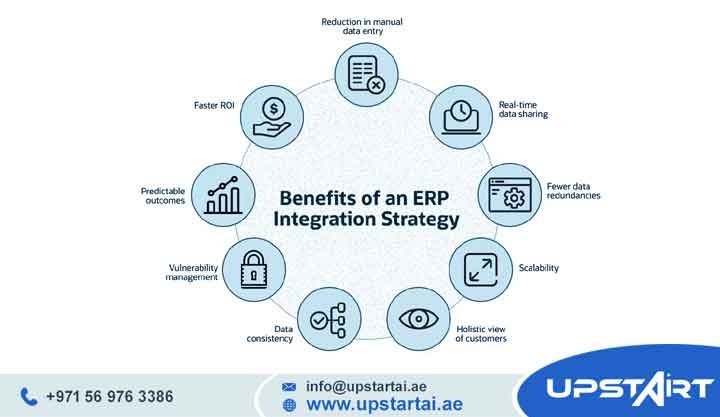
The long-term benefits of ERP connectivity solutions include massive gains in operational efficiency, a reduction in IT maintenance costs, and a much faster time-to-market. By building a connected ecosystem, you create a foundation for future AI and Machine Learning implementations. Your organization becomes more agile and able to pivot in response to market shifts. This is because your data is no longer stuck in silos; it is a fluid asset that supports your growth.
Secure Your Competitive Edge with ERP Integration Best Practices
In the 2026 UAE corporate landscape, the ability to harmonize data is the ultimate competitive differentiator. Choosing to follow ERP Integration Best Practices is a commitment to operational excellence. It ensures your organization remains resilient in a volatile global market. At UpstartAI, we provide the elite engineering and strategic foresight required to turn your disconnected software into a powerful, unified engine of growth. We are here to secure your brand’s future across Dubai, Abu Dhabi, and beyond.
Digital stagnation is a choice that carries a heavy price. Every day you spend managing manual data entry is a day your competitors use to optimize their margins and capture your market share. The gap between the “Data-Integrated” and the “Data-Siloed” is widening, and the window for leadership is closing. Don’t let legacy infrastructure dictate your future. Take control of your trajectory and build a legacy of data-driven success today.
Contact UpstartAI Today Phone: +971 569763386
Email: info@upstartai.ae
Website: www.upstartai.ae