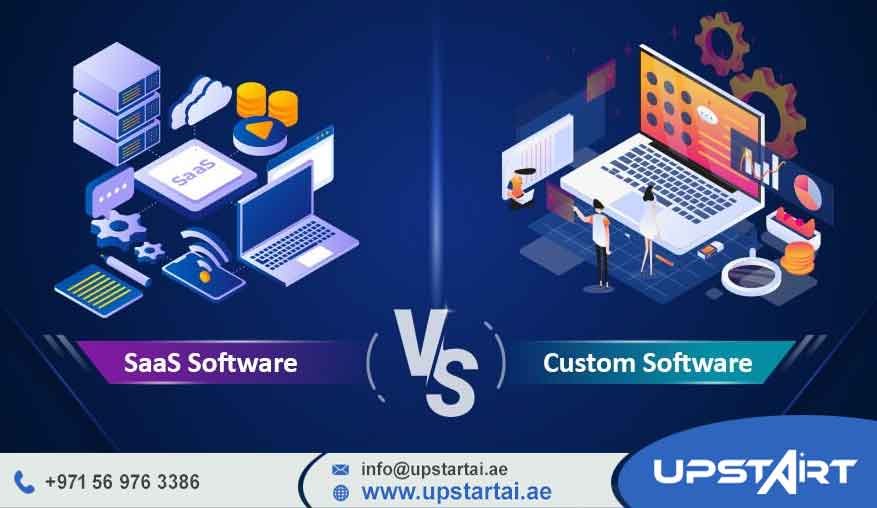
Deciding between a standard cloud setup or building your own software from scratch is probably the biggest technical crossroads a Dubai executive will ever face. It is a tough call. This guide gives you the straight talk you need to balance long-term growth against the need to move fast in today’s Middle East market.
Schedule a Free Call Today
Certified Experts | UAE-Wide Clients | ROI-Focused Campaigns | 10+ Years Experience
Evaluating Strategic Architectures: ERP SaaS vs Custom
The Core Decision Behind ERP SaaS vs Custom
In the fast-moving economy of the United Arab Emirates, your digital systems are no longer just support tools—they drive how much market share you can actually capture. Business leaders in places like DIFC and Abu Dhabi often reach a point where their growing data starts to feel overwhelming. That’s where the real question around ERP SaaS vs Custom begins.
Why SaaS ERP Works for Speed and Simplicity
Cloud-based ERP platforms have gained serious traction across the UAE, and it’s not hard to see why. They’re ready to use, relatively quick to deploy, and remove the need for long development cycles.
With SaaS, you’re essentially skipping years of groundwork. You get built-in security, compliance-ready modules, and structured workflows from day one. For many companies, especially those focused on growth, this is more than enough.
Of course, there’s a trade-off. These systems are built around standard processes, which means your team may need to adjust how they work. For businesses that prioritize speed, lower upfront costs, and operational simplicity, this is usually a fair exchange. The focus shifts from “how we do things” to “how efficiently we can scale.”
Financial Implications and Implementation Timelines in the Dubai Market
Understanding Total Cost: SaaS vs Custom ERP
When businesses run an ERP software comparison SaaS vs custom, the first thing that usually comes up is the five-year cost. And honestly, that’s the right place to start.
SaaS looks very attractive in the beginning. The upfront cost is low, and the pricing fits neatly into a monthly operating expense. For startups in Dubai or companies operating in places like the SAIF Zone, this is a big advantage. It keeps cash flow flexible, which is critical when you’re investing in marketing, hiring, or expansion.
But here’s the part many don’t think about early on. As your business grows, you add more users, more modules, and more features. Those monthly fees start increasing quietly. Over time, they can add up to a significant number—sometimes even more than what a private, custom system would have cost. So, the real choice becomes simple: smaller recurring payments now, or a larger upfront investment with long-term control.
Speed to Market: Why SaaS Wins on Time
Timelines matter a lot in the UAE, especially in fast-moving markets like Dubai. And this is where SaaS clearly has an edge.
A typical cloud ERP implementation can go live in three to six months. That’s especially true if you’re willing to stick close to the standard setup without heavy customization. This kind of speed can be a huge advantage.
Think about situations where regulations change quickly—like VAT updates from the Federal Tax Authority. Businesses don’t have the luxury of waiting a year to become compliant. They need systems that work now. In these cases, SaaS acts like a fast-track solution, helping companies stay competitive and compliant without delays.
Operational Flexibility: ERP SaaS vs Custom ERP
Control vs Convenience in the Cloud ERP vs Custom ERP Debate
When you really break it down, control is at the center of the cloud ERP vs custom ERP conversation. A SaaS model is a bit like renting a fully managed office. Everything is maintained for you—security, updates, new features. But at the same time, you don’t control the setup. If the provider decides to change something, you adjust.
For many UAE businesses, that trade-off works just fine. You don’t have to think about system upgrades or technical maintenance. The vendor is already investing heavily to keep everything modern, secure, and aligned with global standards. That means fewer internal headaches and more time to focus on actual business growth.
When Standardization Becomes a Limitation
But things feel very different when your business isn’t “standard.” If your competitive edge comes from a unique workflow, pricing logic, or sales process, a one-size-fits-all system can start to feel restrictive.
This is where the SaaS ERP vs custom ERP solutions decision becomes more serious. A custom-built system gives you the freedom to mirror your business exactly as it operates. You’re not adjusting your process to fit the software—the software adapts to you.
And here’s the real advantage. If your strategy changes quickly, your system can change just as fast. You’re not waiting months for updates or feature releases. You move when your business needs to move. That kind of agility can make a real difference in competitive markets.
Case Study: Digital Transformation in UAE Manufacturing
A big-name manufacturing firm in the Sharjah Airport International Free Zone (SAIF Zone) recently hit a wall. Their old system just couldn’t handle their growing exports, and they were torn between a global SaaS giant and a custom solution for their specific factory automation. After looking at the long-term math, they went Hybrid. They used a SaaS core for their money and HR, and built a custom MES (Manufacturing Execution System) to handle their unique factory logic. This let them automate their VAT for the FTA instantly while keeping their secret production steps away from prying eyes.
The results changed their business almost overnight. In the first year, they saw a forty percent jump in how much they could produce and a twenty-five percent drop in office errors. By choosing a tailored path, they didn’t get stuck with a bunch of “bloat” features they didn’t need, but they didn’t have to waste time building a finance tool from scratch either. This story is the perfect example of how a smart approach to software—mixing the best of both worlds-can drive real ROI and turn a UAE company into a regional leader in the Fourth Industrial Revolution.
Frequently Asked Questions
What are the primary differences between ERP SaaS vs Custom?
The main difference is about who owns the keys and how much you can change things. SaaS is like renting a very nice, standard apartment where you can’t move the walls, but the landlord handles the repairs. A custom solution is like building your own house exactly the way you want it. For a Dubai business, the choice usually comes down to whether your workflows are “standard” or if you have a very unique way of doing things that the cloud just can’t handle.
Which model is better for VAT compliance under the UAE Federal Tax Authority?
SaaS usually wins on this specific point because the vendors update their tax tools automatically whenever the law changes. You stay compliant without having to think about it. With a custom system, you have to remember to hire a coder to update your tax rules every time the FTA makes a move. A lot of firms here pick the cloud just for that peace of mind, knowing their tax engine is already tuned for the UAE’s specific rules.
How do implementation timelines differ in an ERP SaaS vs custom ERP scenario?
Think of SaaS as a fast-food order and custom as a five-course meal from scratch. A cloud setup can be ready in a few months, which is why it’s so popular in the fast-paced Dubai market where everyone is in a hurry. A custom build, however, can take a year or more because you’re creating something from nothing. It’s a longer wait, but for firms that need every button to do something specific, it’s worth the time.
Can a cloud ERP vs custom ERP handle complex logistics in Jebel Ali?
Both can do the job, but a custom system can be “wired” directly into your specific warehouse machines or tracking tools in a way the cloud can’t. SaaS follows global “best practices,” which works for 90% of companies, but it might not handle your “secret sauce” in shipping. Many big UAE logistics names now use a mix—they use the cloud for the basics and custom code for their most important, unique operations.
What is the total cost of ownership for SaaS ERP vs custom ERP solutions?
SaaS has a low “buy-in” but you never stop paying the monthly rent, which can get expensive as you grow. A custom system has a huge upfront bill that might make you wince, but once it’s built, your ongoing costs are much lower because you own the code. When you do an ERP software comparison SaaS vs custom, make sure you look five years ahead to see which one actually fits your long-term wallet.
How does AI integration impact the off-the-shelf ERP vs custom ERP choice?
Cloud providers are adding AI features like “predictive sales” all the time, giving SaaS users access to the latest tech for “free.” But if you want a custom AI that is trained specifically on your own unique UAE customer data, you need a bespoke system to build it. This lets you create a smart asset that your rivals can’t just buy off the shelf. It’s about whether you want generic AI or a brain that belongs only to your brand.
Conclusion: Making the Right Choice for Your ERP SaaS vs Custom
Choosing the future of your tech is a moment that will define your company for the next ten years. As the UAE keeps leading the charge in digital life, the gap between companies with a real strategy and those “winging it” is getting wider. Whether you pick the fast-scaling cloud or the surgical fit of a custom build, your goal is the same: a system that makes your people’s lives easier and your profits higher.
The truth is, doing nothing costs much more than any software fee. Stagnation leads to losing market share, poor lead quality, and losing your best staff to competitors with better tools. In a market as hungry as Dubai, waiting for the “perfect” time to move is a recipe for getting left behind. By taking the lead now and picking the path that fits your mission, you ensure your business stays a powerhouse in our increasingly digital world.
Schedule a Free Call Today
Phone: +971 569763386
Email: info@upstartai.ae