ERP Vendor Selection Guide
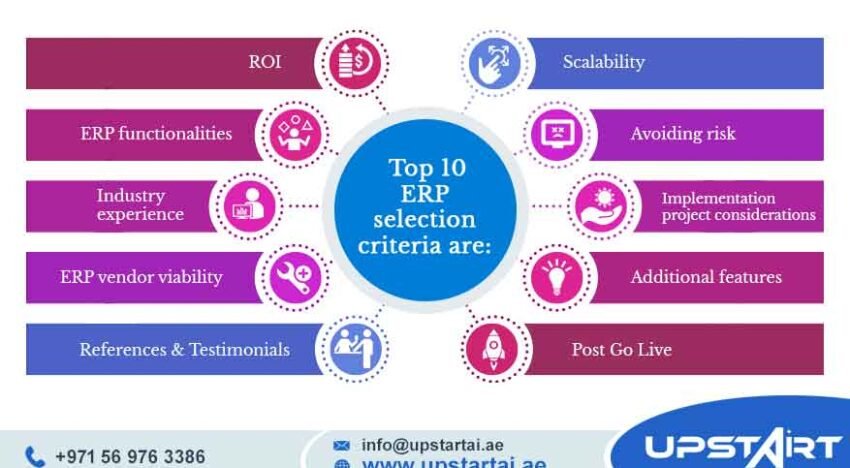
ERP Vendor Selection Guide: The Ultimate 2026 Strategy for UAE Businesses. Picking the right ERP system for your company isn’t just about getting new software; it’s a big move to make sure your business stays ahead in the UAE’s fast-moving digital world. With new AI rules coming in and the 2026 e-invoicing laws just around the corner, getting your ERP vendor selection right is actually more important than ever. At UpstartAI, we take all that confusing technical stuff and turn it into a simple, data-backed plan. Our team of experts helps businesses in Dubai, Abu Dhabi, and across the Emirates look through all the top ERP software providers to find the one that actually fits how you work.
Why Choose Us: Your Trusted UAE ERP Selection Partner
Choosing an ERP implementation partner is a huge deal because you’ll probably be stuck with that system for ten years or even longer. UpstartAI has become a top choice for UAE companies because we mix global standards with real, local knowledge. We know all about the UAE Federal Tax Authority (FTA) rules and the new 2026 e-invoicing pilot programs. We take your data security very seriously, so you can trust us with your private info while we work fast to get you results. Unlike those big global firms that don’t really know Dubai, we are right here on the ground and understand the daily struggles of local SMEs and big enterprises.
Our Comprehensive ERP Consulting & Dashboard Services
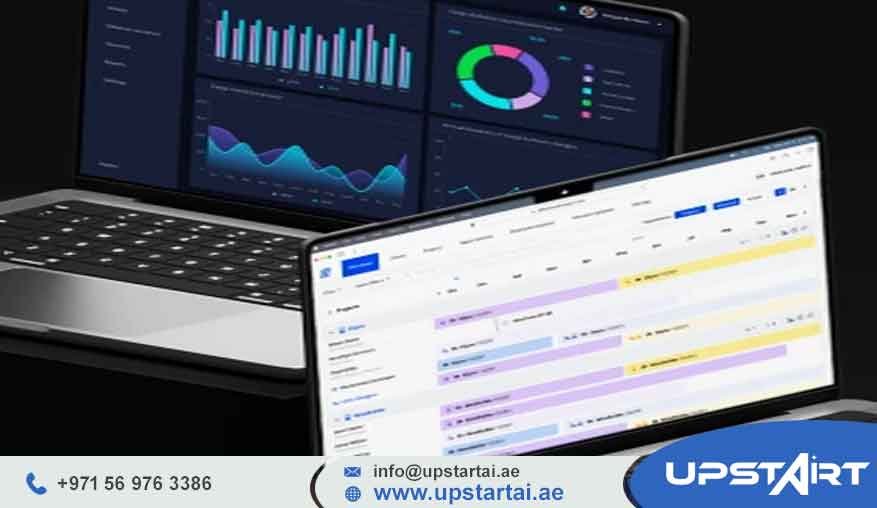
At UpstartAI, we always say an ERP is pretty much useless if it doesn’t give you good info. We offer full ERP vendor selection consulting along with high-end analytics. Here is what we do:
Money & KPI Dashboards: See your cash flow and P&L in real-time, pulled straight from your ERP.
Sales & Marketing Stats: Keep an eye on your sales leads and see if your ads are actually working in the UAE market.
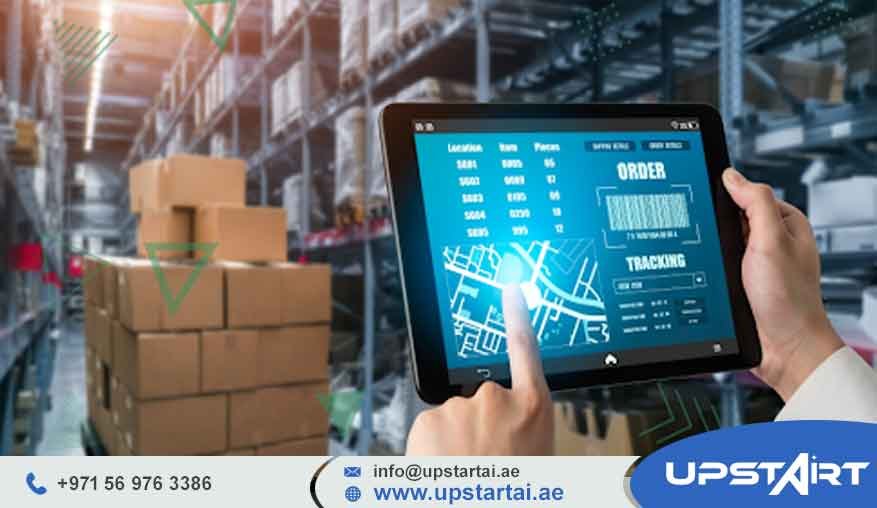
Supply Chain & Operations: Check your stock levels and see how your warehouse is doing.
HR & Payroll: Automate your WPS-compliant payroll and track how your team is performing.
Custom Data Linking: We connect your old systems to the new ERP so everything stays in one place with automated reporting.
Our Proven ERP Selection Methodology: How It Works
We use a very solid, step-by-step ERP vendor selection methodology to make sure you don’t waste money.
First Chat: We start by talking about your business goals and what tech you use now.
Mapping Your Needs: we figure out exactly what the new system must do for you to succeed.
Data Check: We look at your current data to make sure it’s clean enough to move.
Shortlisting: We manage the whole ERP vendor RFP process, cutting the list down to the best 3 or 5 vendors.
Demos & Scoring: We watch the vendor demos with you and use our ERP vendor scoring matrix to see who wins.
Background Checks: We do deep ERP vendor due diligence, checking their references and service promises.
Watching the Build: We stay with you while the system is being built and trained to make sure the vendor does a good job.
The Issues We Fix: Solving Messy Data & Work Problems
A lot of people come to UpstartAI when their current systems are just making life hard. We fix the most common headaches, like:
Too Much Excel: If your staff spends days every month just typing numbers into spreadsheets, our reporting automation will save you a ton of time.
Information Everywhere: We stop that problem where finance and sales have different numbers for the same thing.
Bosses Not Knowing the Truth: We give managers in Dubai and Abu Dhabi a clear view so they can make big decisions without guessing.
Compliance Stress: With the 2026 e-invoicing mandate coming, we help you ditch old software that can’t handle the new FTA formats.
Regional Branch Gaps: For companies with offices in different Emirates, we make sure you can see everything happening in every branch at once.
Transparent Pricing & Investment Insight
We understand that ERP vendor selection services are a strategic investment, so we aim to be clear and upfront about how pricing is determined. Every project is unique, but in the UAE, engagement levels generally fall into two broad categories:
SME Projects:
Typically suited for small to mid-sized businesses that want to move quickly to a cloud-based ERP. These projects focus on faster decision-making, streamlined processes, and minimal disruption to ongoing operations.
Enterprise Consulting:
Designed for large UAE groups and multinational organizations. These engagements are more complex and often involve multiple business units, advanced compliance requirements, integrations with legacy systems, and detailed governance frameworks.
The final investment depends on several factors, including the number of departments involved (such as HR, Finance, or Supply Chain), the condition and complexity of legacy data, integration requirements, and how frequently KPI dashboards and reports need to be updated.
Expert Tips for a Successful ERP Selection
If you want your project to actually work, here’s some friendly advice:
Clean Your Data Early: Don’t move “garbage” data into a new system. Clean it up first!
Think About Integration: Make sure the software can talk to other tools. This is super important for your ERP integration capabilities assessment.
Get Your Team Involved: Change is hard for people. Let your staff try the software during the ERP vendor demo evaluation so they don’t hate it later.
Check Where Data Lives: By 2026, UAE laws mean some data must stay on local servers. Make sure your vendor follows these rules.
Why UpstartAI is the #1 Choice in the UAE
We aren’t just here to give advice — we help you see your business clearly and act with confidence. At UpstartAI, we start with your KPIs, not with software. Before we talk about tools or dashboards, we ask one simple question: Will this help you make more money, reduce costs, or grow faster in the UAE market? That business-first mindset is what makes us different.
Here’s why companies across the Emirates choose us:
1. We Focus on Profit, Not Just Technology
Many tech companies talk about features. We talk about outcomes. For example, if you’re a retail company in Dubai, we focus on increasing sell-through rates and reducing dead stock. If you’re a construction firm in Abu Dhabi, we track project delays, cost overruns, and equipment utilization. Every dashboard we build ties directly to revenue, savings, or efficiency.
2. Fast Results with Proven Templates
We don’t start from zero. We have ready-made dashboard frameworks for industries like retail, finance, logistics, real estate, and equipment rental. This means you don’t wait months just to see results. In many cases, clients get a working version within weeks, not quarters.
3. Simple, Executive-Friendly Design
Our dashboards are built for decision-makers, not just analysts. They are clean, visual, and mobile-friendly, so you can check your numbers from your phone before a meeting. No technical background needed. If you can use WhatsApp, you can use our dashboard.
4. AI That Actually Thinks
We don’t just show past data — we use AI to uncover hidden patterns. For example:
-
Predict which customers are likely to stop buying.
-
Forecast future sales during Ramadan or peak tourism seasons.
-
Detect unusual expenses before they become a problem.
This turns your dashboard from a reporting tool into a decision-making engine.
5. Built for the UAE Market
We understand the local business environment – VAT requirements, seasonal trends, bilingual teams, and regulatory expectations. Whether you operate in free zones like ADGM or run multiple branches across the Emirates, we design systems that fit your real-world operations.
6. Fully Scalable
Whether you’re a small shop in Sharjah tracking daily sales or a large enterprise managing multiple departments, our systems grow with you. Add more users, more branches, or more data sources anytime without rebuilding everything from scratch.
7. Strong Integration Capabilities
Already using SAP, Oracle, Odoo, or custom legacy software? No problem. We connect your existing systems into one “single source of truth” so you stop switching between platforms.
8. Continuous Support and Optimization
We don’t disappear after launch. We monitor performance, fine-tune AI models, and suggest new KPIs as your business evolves. As your goals change, your dashboard evolves too.
Success Stories: Real Results for UAE Leaders
(These are just examples of what we usually achieve for our clients.)
Retail Group: A shop chain in Dubai couldn’t track their stock. After using our ERP vendor selection services, they moved to the cloud. Result: They stopped running out of items and saved 100% of the time they used to spend on monthly reports.
Manufacturing: A factory in Sharjah was using a 15-year-old computer system. Result: We helped them save 20 hours a week and their production planning became 40% more accurate thanks to our operations dashboards.
Frequently Asked Questions (FAQs) – ERP Vendor Selection Guide (UAE)
Choosing the right ERP vendor is a major decision that impacts your operations, costs, and growth for years. Below are detailed FAQs to help UAE businesses make the right choice.
1. How do I choose the right ERP vendor for my business?
Start by identifying your biggest operational challenges-inventory delays, financial reporting gaps, multi-branch management issues, or compliance risks. A good ERP vendor should first understand your business processes before recommending technology.
Example:
A retail company in Dubai with five branches needs real-time stock visibility across locations. The right vendor will focus on inventory synchronization first—not just sell a generic ERP package.
Look for:
-
Industry experience
-
Local UAE compliance knowledge
-
Strong integration capabilities
-
Clear implementation roadmap
2. Should I choose a global ERP vendor or a local UAE partner?
Global systems are powerful, but a local implementation partner understands UAE regulations, VAT rules, language requirements, and market dynamics.
Example:
A company operating in Abu Dhabi Free Zone may have specific compliance requirements. A UAE-based ERP partner will understand those nuances better than an offshore team.
Best practice: Use a strong global ERP platform with a knowledgeable local implementation expert.
3. What questions should I ask an ERP vendor before signing?
Important questions include:
-
How long will implementation take?
-
Where will my data be hosted?
-
What industries have you worked with?
-
What is included in post-launch support?
-
How do you handle system upgrades?
Example:
If a vendor cannot clearly explain how they will migrate your legacy data safely, that’s a red flag.
4. How important is UAE data hosting and compliance?
Very important. UAE’s Personal Data Protection Law (PDPL) requires proper handling and storage of data.
Example:
A finance company in Sharjah must ensure customer financial data stays within UAE-approved cloud environments.
Your ERP vendor should offer:
-
UAE-based cloud hosting (Azure UAE, AWS UAE)
-
Encryption and access controls
-
Audit-ready reporting
5. How long does ERP implementation usually take?
Small to mid-sized businesses: 3–6 months
Enterprise-wide transformations: 6–12 months
Example:
A construction company integrating finance, procurement, and project management modules will take longer than a small trading company implementing accounting and inventory.
A good vendor will offer phased rollouts so you see benefits early.
6. What are the hidden costs in ERP projects?
Common hidden costs include:
-
Data migration cleanup
-
Customization beyond scope
-
Staff training
-
Integration with third-party systems
-
Ongoing support fees
Example:
If your warehouse uses separate scanning software, integration may require additional development.
Always request a transparent cost breakdown.
7. How do I know if an ERP vendor understands my industry?
Ask for:
-
Case studies
-
References in your sector
-
Industry-specific modules
Example:
A chiller rental company needs asset tracking and maintenance scheduling. A generic ERP without equipment lifecycle tracking won’t be enough.
Choose vendors who speak your industry’s language.
8. Should I customize ERP or keep it standard?
Too much customization increases cost and maintenance complexity.
Too little customization may not solve your real problems.
Example:
If your sales commission structure is unique, some customization is necessary. But redesigning the entire finance module may not be wise.
The right vendor balances flexibility with long-term scalability.
9. How do I measure ERP success after implementation?
Success metrics may include:
-
Faster report generation
-
Reduced manual Excel usage
-
Improved inventory turnover
-
Lower operational errors
-
Better VAT compliance
Example:
If month-end closing drops from 10 days to 3 days, that’s measurable ROI.
Set KPIs before implementation begins.
10. What support should I expect after launch?
ERP is not a one-time project. You should expect:
-
Ongoing technical support
-
Performance monitoring
-
User training updates
-
AI or analytics upgrades
-
System optimization as your company grows
Example:
As your business expands into Ras Al Khaimah or Fujairah, your ERP should scale smoothly without needing a complete rebuild.
Contact UpstartAI Today
Ready to get your data sorted and find the right ERP? Whether you are in Dubai, Abu Dhabi, Sharjah, Ajman, Ras Al Khaimah, Fujairah, or Umm Al Quwain, UpstartAI is ready to help.