In the high-stakes corporate landscape of the Middle East, picking your digital foundation is not just a technical chore. It is a massive strategic move that basically sets your company’s path for the next ten years. Using a solid ERP Vendor Selection Guide helps C-suite bosses look past the glossy marketing of global software giants and find the specific tools that actually work in the Gulf. At UpstartAI, we handle the heavy-duty technical auditing needed to make sure your systems work like a high-speed engine for growth. Whether you are in a fancy financial office in the DIFC or a busy industrial site in Abu Dhabi, we are here to protect your digital setup with choices based on hard data.
Running a business in Dubai today means you need a digital backbone that is fast and perfectly in sync with local laws. As the UAE turns into a global tech powerhouse, the hidden price of picking a clunky or non-scalable system is huge. You pay for it in wasted time and messy data. We offer the expert advice and hands-on help needed to bridge the gap between scary, complex software and your daily business wins. Our plan focuses on building things the right way and staying compliant so your company stays fast in a market that never stops moving.
Schedule a Free Call Today.Certified Experts | UAE-Wide Clients | ROI-Focused Campaigns | 10+ Years Experience
Why Top UAE Brands Start with a Specialized ERP Vendor Selection Guide
Choosing a long-term digital partner means finding people who understand how global tech standards hit the reality of local market pressure. Starting with a ERP vendor selection guide lets the people in charge see how different setups handle the big “Buy vs. Build” question we see so often in the Gulf. At UpstartAI, we specialize in cleaning up these messy enterprise environments to get rid of “technical debt”—that annoying baggage that comes after a rushed software launch. In a place where companies grow at lightning speed, systems often fall behind what the business actually needs unless they are checked against local rules.
The truth is, many business groups in Dubai struggle with broken data because of messy updates and international modules that just don’t talk to each other. Our method involves a deep-dive audit of your server health, security, and database speed to keep your infrastructure running lean, no matter which provider you picked. We treat your software like a high-value asset that needs regular care. This stops the sudden crashes that usually happen right when you have a big financial deadline or a massive pile of orders to process. This proactive approach keeps your leadership team in the loop with real facts.
Think of it this way: your digital setup has to handle the Gulf’s tough regulatory environment without breaking a sweat. This means making sure your software calculates VAT perfectly to satisfy the latest FTA rules. A successful evaluation keeps these local details from becoming a legal nightmare or a financial drain. By fixing how your system manages regional data and compliance, we let your team focus on big strategies instead of fixing typos or fighting technical fires all day long.
Mastering the ERP Vendor Selection Process in the Gulf Market
Keeping things stable across all seven Emirates takes a real feel for local tech scenes. A finance firm in the ADGM has totally different data needs than a logistics giant in the Sharjah Airport International Free Zone. At UpstartAI, we tweak our technical fixes to fit these specific spots, making sure your system stays rock-solid even if your branches are far apart. This focused local coverage gives our clients a real edge. It allows them to stay competitive while meeting the high-performance goals that Middle Eastern corporations expect every day.
Critical ERP Vendor Selection Criteria for 2026
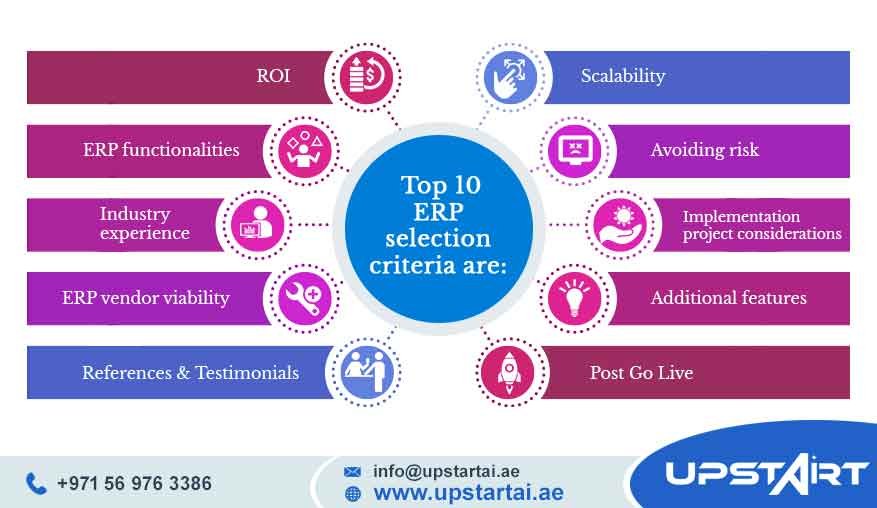
When you do a full audit, you have to look past basic features and focus on how well everything integrates and if it’s ready for AI. In the modern UAE economy, if your system can’t talk to government portals or local banks, it’s a liability. We look at how different platforms handle the massive piles of data seen in Dubai’s real estate and retail sectors. This means digging into the actual code to make sure that as your business grows, your reporting doesn’t slow down to a crawl. Setting up strong ERP vendor selection criteria is really the only way to protect your money.
The real value of a tech audit is finding the “hidden” costs, like being locked into one vendor or seeing your subscription fees creep up every year. Many global brands look cheap at first but then charge a fortune for the specific tweaks needed for UAE labor laws or local shipping. By looking at these systems through a local lens, we help procurement bosses find the ones that actually pay off in the long run. We prioritize platforms that keep data inside the UAE, making sure you follow the country’s growing cybersecurity and data privacy laws.
In the real world, we also test how these systems hold up during the “peak” times, like the Ramadan rush or end-of-year audits. A system that looks great on paper might fail when it has to work with a complex web of Jebel Ali suppliers and global partners. We hunt for architectures that handle data in the background and have smart error-handling. This makes sure that if one small tool fails, it doesn’t freeze your entire finance department. This kind of deep technical checking is what separates a win from an expensive digital disaster.
Compliance Vetting: FTA VAT Readiness and NESA Data Security
How you compare ERP software basically comes down to understanding “technical debt.” That’s the high cost of picking a quick fix over something that lasts. We check how flexible the APIs are on different platforms to make sure they can link up with the AI marketing and automation tools your team is probably already using. A broken system where people have to move data by hand between HR and Finance is a total waste of money. Our tests focus on data accuracy and how fast different departments can talk to each other so your whole company stays in sync.
Strategic Value of a Localized ERP Vendor Selection Process
For a business in a global hub like Dubai, a “one size fits all” approach usually misses the small details of Middle Eastern trade. Local firms need software that handles both Arabic and English without making the data look like gibberish. You also need to manage two different calendars for local and global reporting. We check how “local-ready” different platforms are through a strict ERP vendor selection process. This makes sure you don’t need a massive team of developers just to handle a basic UAE job contract or a warehouse lease in Sharjah.
This strategic alignment also covers how your software manages shipping and local logistics. If your system was built for Europe or the US, it might not have the right modules for the unique customs and free zone rules here. We look for tools that natively support JAFZA or DAFZA regulations, which allows for auto-filing of customs and tracking inventory across different tax zones. This specialized focus makes sure your digital setup actually helps your physical business instead of creating more red tape for your team to deal with.
Beyond just the specs, we look at the local support scene for each platform. A software might be powerful, but if there’s no expert in Dubai who can fix a server crash at 2 AM on a Tuesday, it’s not worth much. We give points to systems that have a real presence here and a history of working with UAE enterprises. This ensures that when your business suddenly grows, you have access to local talent and advice. You won’t be stuck waiting for someone to wake up in a time zone halfway across the planet.
The UpstartAI 3-Step Audit: Discovery → Vetting → Implementation
The first part of our job is a massive “health check.” We use high-tech tools to see exactly where your current setup is starting to buckle under the pressure. Next, we move into a strategy phase where we match your business goals against the strengths of the platforms available today. Finally, we handle the whole selection and launch process, making sure the move to your new system is smooth and actually gets results. This organized approach takes the guessing out of tech buying, giving you a clear path to a better digital future.
Maximizing ROI Through Rigorous ERP Vendor Evaluation
A professional audit should be a map for saving money and protecting your revenue. In the UAE, where running a business isn’t cheap, the efficiency you get from the right system can be the difference between a great year and a bad one. We focus on “value-based” choices, finding the modules that will pay for themselves the fastest. For example, a real estate firm in Abu Dhabi might need a super-fast finance tool, while a factory in Ras Al Khaimah would focus on warehouse management during their ERP vendor evaluation process.
The return on your software investment is also tied to how well it handles “Big Data” right now. We look for systems that have AI built-in, so your team can predict what stock you’ll need or what sales will look like next month. A system that only tells you what happened yesterday just isn’t enough anymore. You need one that tells you what to do tomorrow. By looking at the AI and machine learning features of different providers, we make sure your tech stack is “future-proof” for the next big change in the Gulf.
Lastly, we look at the “Total Cost of Ownership” (TCO) over five years. This includes the obvious fees, but also the hidden ones like training staff, fixing servers, and updating for new UAE laws. A system that looks like a bargain today can become your most expensive headache if it needs constant manual work to stay legal. Our framework gives you a crystal-clear view of these costs. This lets your procurement team make a smart choice based on how it will actually affect your bank balance in the long run.
Solving Operational Friction: From Jebel Ali Logistics to DIFC Finance
In the real world, many Dubai business groups have a “growth gap.” This is when the business is moving faster than the software can keep up. We fix this by finding systems that offer “horizontal scalability.” That’s just a fancy way of saying the software can handle five times the work without slowing down. Whether you are moving cargo in Jebel Ali or managing high-stakes money in the DIFC, we find the tools that fix your specific problems. This keeps your technology as an invisible helper rather than a bottleneck that slows everyone down.
Pricing Insight: Navigating Implementation Costs and License Models in Dubai
Knowing the budget for a professional software check is vital for any smart boss. In the UAE, getting professional help is almost always cheaper than a failed launch. While the price changes depending on how big your company is, we use a transparent model so you know where every Dirham is going. This helps you predict your spending accurately while getting a whole team of experts for less than the cost of one senior in-house salary. It’s about getting the best value for your investment.
Why UpstartAI Is Your Premier ERP System Selection Guide Partner
UpstartAI has built a reputation as the team that fixes the hardest technical mess for the UAE’s top brands. When we act as your ERP system selection guide, we are the partner for companies that can’t afford to be in second place. Our team is made of top-tier architects who have spent years working with the most difficult software setups on earth. We don’t just talk; we get into the data and the code to make sure the systems we suggest are built to survive the unique environment of the Middle East.
What really makes us stand out is how much we know about the local regulatory scene. We get the specific pressures here—from needing to scale fast to the strict FTA rules and data residency laws. This local knowledge lets us offer a selection process that actually makes sense for your daily operations. We speak the language of Middle Eastern trade and treat your tech as if it were our own. That dedication is why so many of the region’s biggest companies have trusted us with their digital projects for over ten years.
At the end of the day, we believe technology should be an invisible helper. It should work so fast and so well that your team forgets it’s even there. Our goal is to get the “sand” out of your digital gears so you can focus on people and strategy. We give you the peace of mind that comes from knowing your main systems are being watched by the best experts in the region. By choosing UpstartAI, you are picking quality, speed, and real results over a quick, surface-level fix.
Expert Advice: Industry Tips for a Successful ERP Vendor Selection Guide
In 2026, any digital plan is incomplete if it doesn’t look at automated intelligence. The best systems now use AI to spot fraud in finance reports and find the best shipping routes across the UAE in real-time. We help our clients figure out which platforms actually have AI built-in and which ones just have “chatbots” added for marketing. This ensures your team spends less time typing and more time making big decisions. Our ERP vendor selection guide focuses on these technical details that actually make a difference.
Think of it this way: AI systems can now predict when a machine in a Sharjah factory is about to break. This “predictive maintenance” saves millions in lost time. When we compare platforms, we look at the quality of their data science and how well they can use info like weather or global shipping delays. This high-level technical check ensures your company stays at the absolute top of the Gulf business world. It’s about having the right tools to win in a digital market.
Case Study: Reclaiming 40% Efficiency via ERP Vendor Evaluation
A big logistics firm in Sharjah was losing hours every week because their old system would crash whenever things got busy. UpstartAI came in, did a full ERP vendor evaluation, and found a modern, cloud-native solution built for high-volume trade. By moving them to a platform with better database speed and real-time links to the Jebel Ali port, we hit 99.9% uptime. They had zero crashes during their busiest season ever. This win allowed the client to handle 40% more orders without hiring more people, proving that picking the right tool is the secret to growth.
FAQs: Navigating the ERP System Selection Guide
How do I use an ERP vendor selection guide for FTA tax compliance?
In the UAE, staying on the right side of the Federal Tax Authority is a must. When you follow an ERP vendor selection guide, you have to check for “native” FTA compliance. This means the system can create a VAT audit file (FAF) with just one click. Many global systems say they are tax-ready, but then you find out you need to buy expensive extra tools just to handle UAE laws. We make sure the systems we suggest have already passed FTA audits for large companies right here in the UAE.
How to choose ERP vendor services that are scalable?
For a growing company in Dubai, learning how to choose ERP vendor partners is really about avoiding “technical debt.” You might be tempted to go with a simple, cheap app, but it will probably break the moment you open an Abu Dhabi branch or start trading across borders. We help firms find “right-sized” solutions that have professional features but a price that fits their current budget. This lets you scale your tech as your revenue grows, so you never get stuck.
What are the top ERP vendor selection criteria for security?
For firms in the UAE, data safety and local rules are the top priorities for the board. Setting the right ERP vendor selection criteria ensures your system follows local data residency laws, keeping your private info inside the country. We also make sure the software is protected against the latest cyber threats that target Middle Eastern businesses. Having a local team means we can be there in person or on a call instantly, providing the high level of security your clients expect.
How does a professional ERP vendor evaluation save money?
A professional ERP vendor evaluation spots tiny glitches before they turn into huge crashes that stop your business for days. By keeping your database clean and your code fast, we also lower the server power you need, which cuts your monthly cloud bills. In the long run, staying ahead of problems is always cheaper than paying for emergency repairs and losing sales while your system is down. By vetting vendors early, you avoid the massive cost of a failed launch.
What is the most important part of the ERP vendor selection process?
The most vital part of the ERP vendor selection process is making sure the tech fits the way your people actually work. A system can be perfect on paper, but if your team hates it, it will fail. We prioritize the user experience and training as much as we do server speed. This makes sure your multi-national team across the Emirates can pick up the new system fast. That leads to quicker data entry and reports you can actually trust to make big decisions.
Does an ERP system selection guide cover multi-currency trade?
The UAE is a global hub, and many local firms deal with partners all over the world. A good ERP system selection guide must make sure your multi-currency tools stay updated with the latest exchange rates and tax rules automatically. This is huge for knowing your actual profit when you are buying from international suppliers. By taking away the manual math of balancing different currencies, we let your finance team focus on cash flow and global growth without worrying about human errors.
Final Call to Action: Start Your ERP Vendor Selection Guide Today
Choosing to start a professional ERP Vendor Selection Guide is the smartest move you can make for your company in 2026. In a market as fast as the UAE, your tech needs to be a rocket, not an anchor. At UpstartAI, we have the local experience and the technical skills to turn your biggest office headaches into your biggest wins. Do not let “technical debt” limit your vision; let us help you build the digital heart your business deserves.
The truth is, standing still is a direct threat to your market position. Every day your system stays manual, messy, or slow is a day of lost data and wasted profit. Take control of your digital future right now and make sure your company is powered by the best tools in the region.
Contact UpstartAI Today
Phone: +971 569763386
Email: info@upstartai.ae