
Unify your technical oversight and executive reporting with AI-driven clarity. Transform fragmented development cycles into high-performance, compliant assets.
[Schedule a Free Call Today]
Certified Experts | UAE-Wide Clients | ROI-Focused Campaigns | 10+ Years Experience
The Strategic Necessity of Software Development Governance in the Modern Enterprise
In the rapidly evolving digital landscape of the Middle East, the ability to scale technical operations while maintaining rigorous oversight is no longer a luxury—it is a survival mandate. For major enterprises operating out of the DIFC or ADGM, the complexity of managing distributed engineering teams often leads to “black box” development where costs spiral and quality remains opaque. Implementing a robust Software Development Governance strategy allows organizations to move from reactive troubleshooting to proactive value creation. By establishing clear guardrails around code quality, security protocols, and architectural standards, firms can ensure that every line of code written contributes directly to the bottom line.
Modern governance is not about slowing down innovation; rather, it is the framework that makes rapid innovation safe. When a Dubai-based financial institution or a logistics giant in Jebel Ali deploys new digital services, they face unique regional pressures, including data residency requirements and specific cybersecurity mandates. A centralized governance model provides the structural integrity needed to navigate these complexities. It ensures that technical debt is managed, documentation is maintained, and compliance is “baked in” rather than added as an afterthought.
Furthermore, the integration of Artificial Intelligence into this oversight layer has revolutionized how we perceive technical audits. Traditional governance relied on quarterly reviews and manual spreadsheets—methods that are inherently obsolete by the time they are published. Today, leading UAE brands utilize automated dashboards to gain real-time visibility into their software assets. This transition from manual oversight to automated intelligence is the hallmark of a mature digital organization, allowing leadership to make data-driven decisions with absolute confidence in their technical infrastructure.
Why UAE Enterprises Prioritize a Specialized IT Governance Framework UAE
Adopting a localized IT governance framework UAE is essential for organizations that must balance international best practices with regional regulatory nuances. The UAE’s digital economy is characterized by a high degree of integration between the public and private sectors, often requiring adherence to standards set by the Dubai Electronic Security Center (DESC) or the National Electronic Security Authority (NESA). A generic framework often fails to account for these localized security layers, leaving organizations vulnerable to compliance gaps that can result in significant legal and financial repercussions.
Beyond compliance, a dedicated framework facilitates better resource management across the seven Emirates. Whether you are managing a construction tech project in Ras Al Khaimah or a luxury retail platform in Umm Al Quwain, the ability to standardize delivery metrics is crucial. It allows procurement heads to evaluate vendor performance through a standardized lens, ensuring that outsourced development meets the same rigorous quality gates as in-house builds. This level of standardization is particularly vital for the UAE’s burgeoning SME sector, where capital efficiency is the primary driver of long-term growth.
The implementation of such a framework also addresses the cultural and operational diversity of the UAE workforce. With tech teams often comprised of international talent, a unified governance document serves as the “single source of truth.” It defines the “how” and “why” of software production, reducing friction between departments and accelerating the onboarding process for new engineers. By codifying these expectations, UAE enterprises can build a culture of accountability that transcends geographical and cultural boundaries, fostering a more resilient and agile technical ecosystem.
Scaling Performance with Enterprise Software Governance Dubai
For corporations headquartered in the heart of the city, enterprise software governance Dubai represents the gold standard in operational excellence. The city’s push toward becoming a global AI hub means that local firms are under immense pressure to integrate machine learning and autonomous systems into their core offerings. However, without a governance layer, AI integration can lead to “unstructured innovation,” where experimental projects never reach production or create significant security vulnerabilities. Our approach ensures that every AI initiative is governed by the same rigorous standards as traditional software.
Enterprise-level governance specifically targets the reduction of technical debt, which is often the silent killer of digital transformation projects in the Middle East. Many firms in the real estate and hospitality sectors find themselves hampered by legacy systems that cannot communicate with modern APIs. A dedicated governance strategy provides the roadmap for legacy modernization, ensuring that new investments are compatible with existing infrastructure. This prevents the creation of data silos and ensures a unified user experience across all digital touchpoints, from mobile apps to web portals.
Moreover, the fiscal implications of high-level governance cannot be overstated. In a market where VAT compliance and FTA regulations require precise financial reporting, software that handles transactional data must be beyond reproach. Enterprise governance ensures that every financial module is audited for accuracy and security. By establishing these high-stakes quality gates, Dubai-based firms can protect their reputations and maintain the trust of their global partners, proving that they operate at the same—if not higher—levels of technical rigor as their counterparts in Silicon Valley or London.
Navigating Complexity with Software Project Governance UAE
Successful delivery of large-scale digital assets requires more than just skilled developers; it requires a structured software project governance UAE methodology. This is especially true for multi-stakeholder projects involving government entities or large conglomerates. Project governance provides the oversight needed to manage scope creep, budget overruns, and timeline shifts. By implementing real-time reporting dashboards, project managers in Abu Dhabi or Sharjah can identify bottlenecks in the development lifecycle before they impact the launch date, ensuring that go-to-market strategies remain on track.
One of the primary advantages of a localized project governance approach is its ability to handle the specific logistics of the region. For instance, a logistics company operating out of Fujairah Port may require complex integrations with customs systems and international shipping APIs. Governance ensures that these integrations are performed using standardized protocols, reducing the risk of system failure during peak operational hours. It also mandates rigorous testing phases, including User Acceptance Testing (UAT) that reflects the multilingual and diverse user base found across the UAE.
Additionally, project governance serves as a vital communication tool for C-suite executives. High-level dashboards translate technical jargon into business metrics, such as “percentage of feature completion” or “risk of delay.” This transparency is crucial for maintaining investor confidence and securing future funding for digital initiatives. In a competitive market like the UAE, the ability to demonstrate a disciplined, risk-mitigated approach to software production is a significant competitive advantage that attracts top-tier talent and high-value partnerships.
The Evolution of Digital Governance in Software Development
The transition toward digital governance in software development marks a shift from reactive monitoring to the use of autonomous, AI-driven oversight. In the past, governance was a manual process of checking boxes; today, it is a dynamic system that uses machine learning to predict potential failures. AI agents now monitor code repositories 24/7, flagging security vulnerabilities or performance regressions the moment they are committed. This “shift-left” approach to governance means that issues are solved at the earliest possible stage, drastically reducing the cost of remediation.
For a tech founder in the Sharjah Research Technology and Innovation Park, this means they can scale their engineering team rapidly without losing control over the quality of their product. Digital governance tools provide automated documentation and traceability, which are essential for startups looking to exit or raise Series A funding. Investors increasingly look for “clean” codebases and documented governance processes as a sign of a mature, scalable business. By automating these processes, founders can focus on product-market fit while the governance system handles the technical guardrails.
As we look toward the future, the role of AI in governance will only expand. We are moving toward a reality where governance systems can suggest architectural improvements or automatically reallocate cloud resources based on real-time traffic patterns in Abu Dhabi or Dubai. This level of “self-healing” infrastructure is the ultimate goal of digital governance. It ensures that software systems are not only compliant and secure but also optimized for maximum performance and cost-efficiency, reflecting the UAE’s vision for a world-class, AI-first digital economy.
Implementation Timelines and ROI in the UAE Market
Implementing a comprehensive governance strategy is a phased process that typically spans 3 to 6 months, depending on the size of the organization. The first phase involves a deep-dive audit of existing workflows and technical assets. In the UAE, this often includes evaluating how local data laws affect cloud hosting decisions. By the second month, organizations usually begin the integration of automated reporting tools, connecting their CI/CD pipelines to centralized dashboards. This provides immediate visibility into development velocity and code quality, often revealing low-hanging fruit for immediate optimization.
The Return on Investment (ROI) for governance becomes evident by the end of the first quarter post-implementation. Organizations typically see a 20-30% reduction in “re-work”—the time developers spend fixing bugs that should have been caught earlier. For a Dubai-based enterprise with a team of 50 developers, this translates to thousands of man-hours saved annually. Furthermore, the reduction in security risk and the avoidance of compliance fines provide a “hidden” ROI that protects the company’s long-term valuation and operational stability.
Case Study: Digital Transformation in the UAE Real Estate Sector
A prominent Abu Dhabi-based real estate developer was struggling with a fragmented digital ecosystem. They had multiple vendors building various parts of their customer portal, leading to inconsistent security standards and a poor user experience. UpstartAI implemented a unified governance framework that standardized all third-party development. By introducing automated quality gates and a centralized reporting dashboard, the developer was able to identify a major security flaw in their payment gateway before it was exploited. This intervention saved an estimated AED 2.5 million in potential fraud losses and allowed the firm to launch their integrated “Smart Community” app three weeks ahead of schedule.
Frequently Asked Questions
How does software development governance UAE impact the speed of delivery? Contrary to the belief that oversight causes delays, a structured approach actually accelerates delivery by reducing the time spent on bug fixes and technical debt. By establishing clear standards from the outset, developers spend less time guessing and more time building high-quality features. This leads to a more predictable and sustainable development velocity for enterprises across the Emirates.
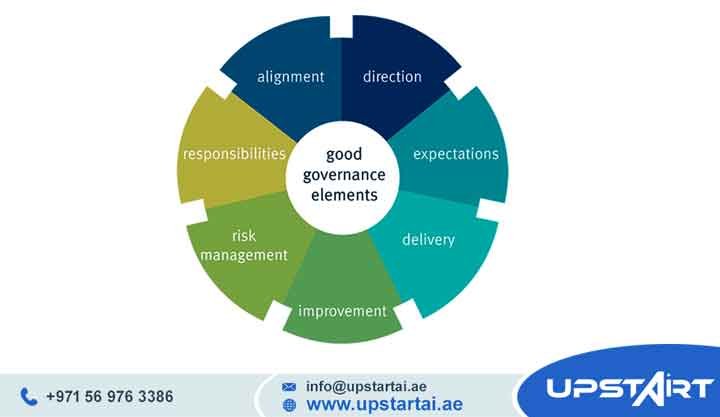
What are the core components of a modern IT governance framework UAE? The framework should include automated code analysis, standardized security protocols aligned with NESA/DESC, architectural guidelines, and real-time executive dashboards. It also requires a clear definition of roles and responsibilities to ensure accountability throughout the software lifecycle. These components work together to create a transparent and secure development environment.
Can enterprise software governance Dubai help in managing third-party vendors? Yes, it is one of the most effective tools for vendor management. By requiring all external partners to adhere to your internal governance standards and report through your dashboards, you maintain total control over the quality of the deliverables. This ensures that you get exactly what you paid for and that the code is easy to maintain once the contract ends.
Is software project governance UAE necessary for smaller tech startups? Absolutely, as it builds the foundation for future scaling. Startups that implement basic governance early on find it much easier to pass due diligence during funding rounds and can onboard new developers 40% faster. It prevents the “spaghetti code” trap that often leads to the failure of promising tech ventures in the region.
How does digital governance in software development handle data privacy? Our digital systems are designed to automatically flag any code that handles sensitive PII (Personally Identifiable Information) in a way that violates UAE Data Protection Laws. By automating these checks, we ensure that your software remains compliant with evolving privacy regulations without requiring manual audits for every minor update.
What is the role of AI in your governance reporting tools? AI acts as a predictive layer that analyzes historical data to forecast potential project delays or security risks. It can identify patterns that human auditors might miss, such as a subtle decline in code maintainability over several sprints. This allows leadership to intervene early and keep projects on the path to success.
Secure Your Future with Software Development Governance
The cost of digital stagnation is far higher than the investment in structured oversight. In a marketplace as competitive as the UAE, organizations that operate without clear technical guardrails risk falling behind more agile, data-driven competitors. Poorly governed software leads to security breaches, operational downtime, and wasted capital—factors that can cripple even the most established Dubai-based brands.
By partnering with UpstartAI, you are choosing a partner that understands the intersection of high-level engineering and regional business reality. We don’t just provide software; we provide the clarity and control you need to lead your industry.
Contact us today to begin your journey toward technical excellence.
UpstartAI Phone: +971 569763386 Email: info@upstartai.ae Web: www.upstartai.ae